







The Solar System's Turbulent Moon
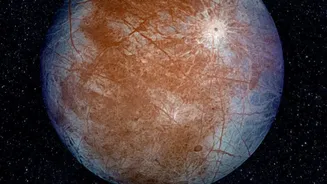
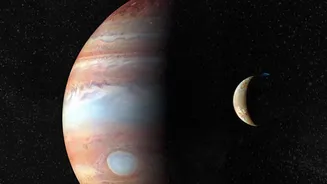
Io is a world of violent extremes. With over 400 known volcanoes, it is constantly being reshaped by eruptions that send plumes of material hundreds of kilometres into space. This incredible activity isn't driven by internal heat left over from its formation,
but by a relentless gravitational tug-of-war. Caught between the immense gravity of Jupiter and the pulls of fellow moons Europa and Ganymede, Io is continuously stretched and squeezed. This process, known as tidal heating, generates tremendous friction and heat deep within the moon, making its interior far hotter than Earth's. Until now, our understanding of this heat came almost entirely from infrared instruments that could only read the temperature of the very top layer of its surface.
A New Way of Seeing
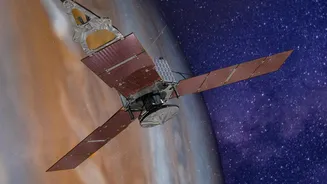
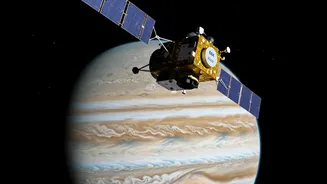
The breakthrough came from an ingenious use of one of Juno's instruments during two close flybys in late 2023 and early 2024. The spacecraft’s Microwave Radiometer (MWR) was originally designed to peer deep beneath the clouds of Jupiter's atmosphere. Scientists realised that if the instrument could penetrate the gas giant's thick atmosphere, it might also be able to probe into the rocky crust of Io. The gamble paid off. The MWR’s antennas, which detect a range of microwave wavelengths, were able to sense thermal emissions from depths ranging from a few inches down to tens of feet below the surface, effectively giving scientists a subsurface heat map.
What Juno Discovered
The findings were stunning. Everywhere the instrument looked, the temperature rose significantly just a few metres below the ground. Shannon Brown of NASA's Jet Propulsion Laboratory noted that temperatures increased by more than 22 degrees Celsius in the first few feet, a gradient far too steep to be explained by sunlight alone. This indicates that heat from the moon's interior is constantly leaking out across its crust. The data also revealed something unexpected: at microwave frequencies, Io's surface appears remarkably smooth. This suggests the upper crust is composed of a low-density, porous material, perhaps like fine-grained volcanic ash or pumice, which acts as an effective insulator.
Rewriting the Book on Volcanic Worlds
These direct measurements are transforming our understanding of how tidally heated worlds work. By characterising how heat moves from Io's interior to its surface, scientists can now test and refine models of its internal structure, including the long-theorised presence of a global magma ocean. The discovery that heat is escaping across the moon, and not just through its massive volcanoes, provides a crucial new piece of the puzzle. According to Scott Bolton, Juno's principal investigator, this new technique has significant implications beyond Io. It provides a new tool for studying volcanism across the cosmos and could even be applied to volcanoes here on Earth to better understand their mechanics.