


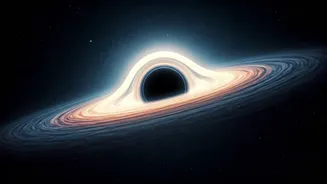


A Galactic Centre of Gravity
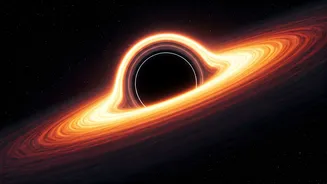
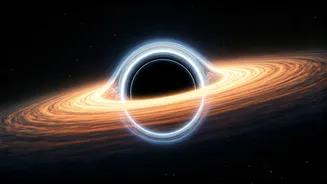
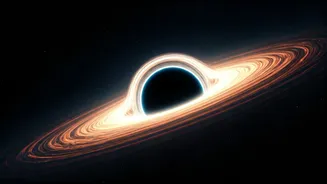
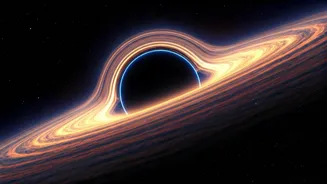
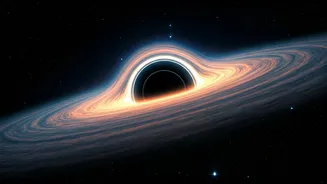
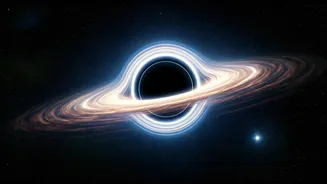
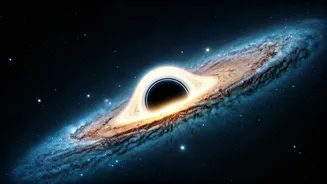
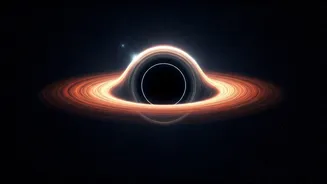
Every large galaxy, including our own Milky Way, is thought to have a supermassive black hole at its core. Ours is named Sagittarius A, or Sgr A for short. It's an object of immense density with a mass four million times that of our sun, located about
26,000 light-years from Earth. For decades, scientists have studied Sgr A, noting that compared to the violent, brightly-lit black holes seen in other galaxies—known as active galactic nuclei (AGN)—ours is remarkably peaceful. Its consumption rate is famously low; one analogy suggests it is equivalent to a human eating just one grain of rice every million years. This has made it an ideal laboratory for studying black holes in their more common, quiet state.
The 50-Year Search for a Breeze
Astrophysical theory has long predicted that as black holes feed on surrounding gas and dust, they don't just swallow everything. The process of accretion—matter spiralling inwards—should heat up the material, generating immense radiation and pressure that pushes some of it back out into space. This outflow is known as a 'black hole wind'. While powerful winds and jets have been clearly observed blasting from active black holes in distant galaxies, finding evidence of a wind from the demure Sgr A proved elusive for fifty years. The view to the galactic centre is obscured by dense gas, dust, and stars, making clear observations incredibly challenging.
A Breakthrough Observation
A recent study led by researchers at Northwestern University has finally provided the long-sought evidence. Using combined data from the Atacama Large Millimeter/submillimeter Array (ALMA) in Chile and NASA's Chandra X-ray Observatory, scientists created an unprecedentedly detailed map of the region immediately surrounding Sgr A. By applying new data processing techniques, they were able to produce an image 80 times sharper than previous maps. The result was stunning: they discovered a vast, cone-shaped cavity in the cold gas pointing directly away from the black hole. This void, about three light-years long, was exactly where it shouldn't be if the area was undisturbed.
Explaining the Empty Space
The research team considered several explanations for this cone-shaped void. One possibility was that winds from the many massive stars packed into the galactic center had cleared out the gas. However, after calculating the energy required to create such a large cavity, they concluded that stellar winds alone were not powerful enough. The only explanation that fit the data was a hot, energetic wind emanating from the supermassive black hole itself. The X-ray data from Chandra confirmed the presence of hot gas within the very cavity where ALMA saw an absence of cold gas. The wind from Sgr A* was either sweeping the cold gas away or heating it to the point that it became invisible to ALMA's radio observations.
Why a Gentle Wind Matters
This discovery confirms that even quiet, slowly-feeding black holes are not passive objects. They are constantly interacting with and shaping their galactic environments. The wind from Sgr A is described as more of a 'gentle breeze' compared to the 'hurricanes' produced by more active black holes, but its effects are profound. Such outflows, known as astrophysical feedback, regulate the growth of galaxies. By blowing away gas, the black hole can limit its own food supply and also starve the surrounding area of the raw material needed to form new stars. Researchers estimate this wind has been blowing for at least 20,000 years, demonstrating that Sgr A is a persistent, if subtle, architect of the Milky Way's core.