




The Challenge: Bringing Astronauts Home Safely
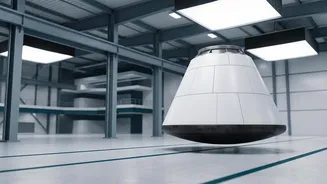
Sending humans to space is only half the mission; the other, more complex half is ensuring their safe return. The Gaganyaan Crew Module, the pressurised capsule where Indian astronauts will live, is the heart of this endeavour. Before it can carry a human,
every single component and procedure must be tested to its limits on the ground. This process, known as qualification, is a non-negotiable part of human spaceflight. The recent focus has been on separation systems—the mechanisms that ensure different parts of the spacecraft come apart exactly when they are supposed to, from leaving the rocket to landing in the ocean.
Test 1: A Clean Break from the Service Module
One of the most crucial tests focused on the Crew Module-Service Module Connect & Disconnect System (CS-CDS). The Service Module is the powerhouse attached to the crew capsule, supplying electricity and propulsion in orbit. Before the Crew Module begins its fiery re-entry into Earth's atmosphere, it must cleanly separate from the Service Module. Any failure here could be catastrophic. ISRO engineers tested the umbilical separation, which acts as the link for power and fluids between the two modules. The test successfully demonstrated a clean separation, ensuring the Crew Module's structure remained stable and ready for the journey home.
Test 2: Surviving the Parachute Deployment
Once the capsule is falling back to Earth, it needs to slow down dramatically. This is done with a sequence of parachutes. But before the main parachutes can open, a protective shield called the 'Apex Cover' must be jettisoned. This separation is a violent event, triggered by pyrotechnic thrusters that blast the cover away. The second major qualification test validated the Crew Module's structural integrity during this event. Engineers applied forces equivalent to 1.75 times the expected load to a simulated Crew Module to ensure it could withstand the shock without any damage, confirming the design is robust enough for flight.
Test 3: Ensuring a Safe Splashdown
Gaganyaan's journey ends with a splashdown in the ocean. However, a capsule can sometimes land upside down in the water, a dangerous situation for the crew inside. To counter this, ISRO has developed the Crew Module Uprighting System (CMUS). This system uses high-pressure cold gas to inflate a set of flotation bags around the capsule, which automatically turn it to the correct upright position. The third successful test involved demonstrating this system, ensuring the bags inflated at the right time and with enough force to right the module under various conditions, making it stable for astronaut recovery.
What This Means for Gaganyaan's Timeline
These successful tests are significant milestones that de-risk critical phases of the mission and move Gaganyaan closer to its first uncrewed flight. The mission, which aims to make India the fourth nation to independently send humans to space, is proceeding with a safety-first approach. Before any astronauts, known as Gaganyatris, take flight, ISRO will conduct a series of uncrewed missions to validate every system in a real-world space environment. The first of these, G1, is expected to launch in late 2026 or early 2027 and will carry the humanoid robot Vyommitra to simulate an astronaut's presence. The successful completion of these ground qualifications shows that the complex hardware is meeting its design requirements, building confidence for the even more challenging tests that lie ahead.