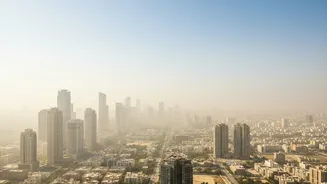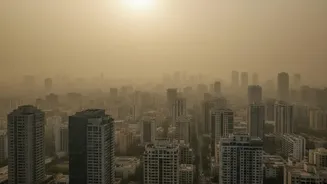








The Pollutant You Can't See
Unlike the familiar haze of particulate matter, ground-level ozone is an invisible gas. It’s not emitted directly from tailpipes or chimneys. Instead, it forms when other pollutants, mainly nitrogen oxides (NOx) and volatile organic compounds (VOCs) from vehicle
exhaust and industrial emissions, react in the presence of sunlight and heat. This is why it’s often called a 'secondary pollutant'. While the ozone layer high in the atmosphere protects us, this ground-level version is harmful to breathe, aggressively attacking lung tissue. As cities get hotter, the conditions for creating this toxic gas become more favorable, turning sunny days into a health risk.
CSE's Alarming Findings
The latest analysis from the Centre for Science and Environment paints a worrying picture based on six years of data from 25 cities. It concludes that ozone is no longer just a summer problem in north India but a widespread, multi-season crisis. During a 71-day study period between March and May 2026, Delhi-NCR exceeded the national eight-hour safety standard every single day. On an average day, nearly nine monitoring stations across Delhi recorded violations, with NCR towns like Greater Noida and Ghaziabad also consistently showing dangerous levels.
A Nationwide Challenge
While Delhi-NCR is the most persistent hotspot, the problem is national. The CSE report highlights that 15 of the 25 cities studied recorded summer averages above the national safety standard. Chandigarh recorded the highest average summer concentration, followed by Jaipur and Ahmedabad. Cities like Mumbai, Bengaluru, and Chennai are also severely affected, showing that southern and coastal regions are now grappling with significant ozone pollution. In some cities, the exposure is prolonged; Bhopal, for instance, saw unsafe levels for an average of 17 hours a day. This transforms the issue from a localized winter concern into a year-round, country-wide health threat.
More Than Just a Cough
Exposure to ground-level ozone has serious health consequences. Short-term effects include coughing, throat irritation, and difficulty breathing. For vulnerable populations—children, the elderly, and people with asthma or other lung diseases—the risks are much higher, leading to more frequent asthma attacks and hospital visits. Long-term exposure is linked to chronic respiratory illnesses, cardiovascular problems, and even premature death. The CSE report underscores that this is not a minor irritant but a major public health hazard that demands urgent attention.
The Dangerous Feedback Loop
The connection between ozone and climate change creates a vicious cycle. As a greenhouse gas, ground-level ozone traps heat in the atmosphere, which contributes to rising temperatures. These higher temperatures, in turn, accelerate the chemical reactions that produce even more ozone. Anumita Roychowdhury, the executive director of CSE, calls this a "dangerous feedback loop." This cycle not only worsens air quality but also has broader environmental impacts, including reduced agricultural productivity, as ozone can damage crops like wheat.
What's the Path Forward?
The CSE's analysis calls for a strategic shift in India's clean air policy. While the National Clean Air Programme (NCAP) has focused primarily on particulate matter, experts now argue it must adopt a multi-pollutant framework. This means implementing targeted strategies to reduce the precursor gases—NOx and VOCs—that form ozone. Key steps include accelerating the transition to cleaner fuels and zero-emission vehicles, controlling industrial emissions more stringently, and managing air quality on a regional 'airshed' basis rather than city by city. Addressing ozone requires tackling its root causes, which are deeply embedded in urban transport, industry, and energy use.