




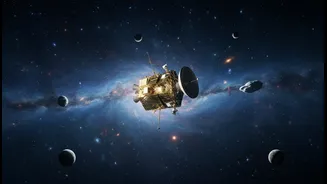


A Journey Beyond Pluto
Launched in 2006, NASA's New Horizons spacecraft completed its primary mission with a spectacular flyby of Pluto in July 2015, transforming our view of the dwarf planet from a fuzzy dot into a complex world with icy mountains and a vast frozen heart.
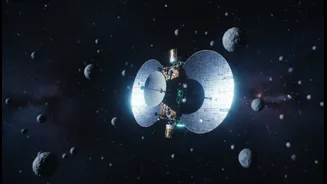
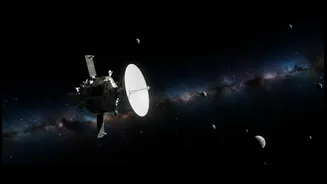
But for this intrepid explorer, Pluto was just the beginning. The mission was always intended to push deeper into the solar system's 'third zone' — the Kuiper Belt. This vast, donut-shaped region beyond Neptune is a reservoir of icy bodies, primordial remnants from the formation of our solar system some 4.5 billion years ago. New Horizons is the first mission designed to explore this distant, frozen frontier up close.
Rendezvous with Arrokoth
On New Year's Day 2019, New Horizons made history again. It successfully performed a flyby of a Kuiper Belt Object (KBO) named Arrokoth, located a staggering 1.6 billion kilometres beyond Pluto. This made Arrokoth the most distant and most primitive object ever explored by a spacecraft. The images sent back revealed a remarkable object: two reddish, planet-like bodies gently fused together, resembling a snowman. This 'contact binary' offered scientists an unprecedented look at the building blocks of planets, preserved in the deep freeze of space for billions of years.
A Lonely Sentinel's Watch
So, what is the probe doing now? After a nearly year-long hibernation to conserve power, New Horizons woke up in good health in late June 2026, now more than 9.5 billion kilometres from Earth. Radio signals confirming its status took almost nine hours to reach us. Though a search for another flyby candidate was unsuccessful, the mission is far from over. New Horizons has transitioned into a unique deep-space observatory. Its instruments continue to study the solar wind, the charged particles streaming from the sun, and measure the dust environment of the Kuiper Belt. Its unique vantage point, far from the sun, provides data no other active mission can.
Pushing Towards the Void
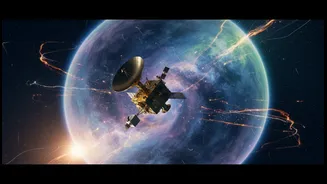
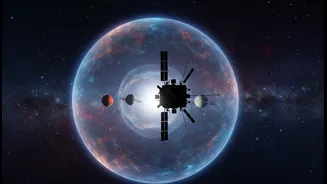
The spacecraft is currently travelling at around 480 million kilometres per year, speeding away from the sun. Its primary challenge is power. The plutonium-based generator that gives it life is slowly decaying, forcing mission operators to manage its resources carefully. Despite this, the probe is collecting invaluable information about the heliosphere — the protective bubble of plasma created by the sun. Scientists are particularly interested in when New Horizons will cross the 'termination shock', the boundary where the solar wind dramatically slows down. This crossing, predicted to occur between 2029 and 2040, will mark its entry into interstellar space.