







The Latest Bombshell Prediction
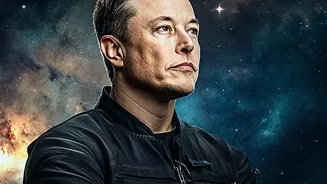
During a recent interview, Elon Musk laid out one of his most aggressive timelines yet for the evolution of artificial intelligence. He stated that AI's overall intelligence could exceed that of all humans combined in about five years. Looking further
ahead, he suggested that within a decade, the intelligence gap between AI and humans could be as vast as the one between humans and chimpanzees. This vision, tied to the work at his company xAI, accelerates previous forecasts and places immense pressure on the entire industry. Musk believes this leap will lead to an "era of astonishing abundance," where AI and robots produce nearly all goods and services, potentially making concepts like money irrelevant by 2036.
Superintelligence vs. Smart AI
It's crucial to understand what Musk means by 'superintelligence'. Today's AI is considered 'Narrow AI' (ANI), skilled at specific tasks like playing chess or language translation. The next theoretical step is Artificial General Intelligence (AGI), an AI with the ability to learn, reason, and perform any intellectual task that a human can. Artificial Superintelligence (ASI) is the stage beyond that. It refers to an intellect that is vastly smarter than the best human minds in practically every field, including scientific creativity, general wisdom, and social skills. While AGI aims for human-level parity, ASI implies a level of cognitive power that is difficult for us to even comprehend.
A Reality Check from the Experts
While Musk's predictions are compelling, many experts in the field urge caution and express skepticism. For instance, Meta's chief AI scientist, Yann LeCun, has previously called such near-term AGI timelines unrealistic, arguing that current models lack the fundamental reasoning and understanding of the physical world. Other researchers point to significant hurdles that remain, including the immense energy requirements, shortages of advanced computing chips, and the unresolved challenge of AI safety and alignment. Many analysts believe a more realistic timeline for AGI, let alone ASI, is closer to the 2030s or 2040s, highlighting the foundational scientific breakthroughs that are still needed.
The High-Stakes Race for Dominance
Musk's bold claims are part of a larger, high-stakes competition for AI supremacy. His company, xAI, is in a direct race with giants like Google's DeepMind and the company he co-founded, OpenAI. This race is fueled by unprecedented levels of investment, with projected spending on AI-centric systems expected to surpass $300 billion by 2026. The strategy, particularly for xAI, appears to be a bet on brute-force scaling—the idea that massive increases in computing power, using hundreds of thousands of GPUs, can overcome current algorithmic limitations. This aggressive approach has a ripple effect, impacting everything from the global supply chain for chips to the energy grids needed to power these massive data centres.
Implications for India's Tech Future
For India, the race toward superintelligence presents both immense opportunities and significant challenges. As a global hub for tech talent and IT services, India is well-positioned to contribute to and benefit from the AI revolution. An accelerated timeline means the country must move quickly to upskill its workforce, foster domestic AI research, and create policies that encourage innovation while managing potential disruptions. The demand for AI developers, data scientists, and ethics professionals will only intensify. Furthermore, as AI begins to automate more complex tasks, India's service-led economy will need to adapt, shifting its focus from traditional IT roles to higher-value-added services in AI implementation, customisation, and governance.