






What Exactly Is a Blazar?
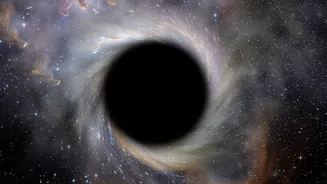
The object in question isn't just any black hole. It's a specific, hyper-energetic type known as a blazar. At the heart of many galaxies, including our own Milky Way, lies a supermassive black hole millions or even billions of times the mass of our sun.
Most are relatively quiet, but some are 'active', meaning they are voraciously feeding on surrounding stars, gas, and dust. This material forms a swirling, superheated disc around the black hole. In some cases, this process becomes so intense that the black hole launches two powerful jets of particles from its poles at nearly the speed of light. When one of these jets happens to be pointed almost directly at Earth, astronomers call that object a blazar. It’s a matter of cosmic alignment, like staring straight down the beam of a powerful torch from a great distance.
Catching a 'Ghost Particle'
The particles being beamed our way aren't asteroids or debris, but something far more elusive: neutrinos. These subatomic particles are often called 'ghost particles' because they have almost no mass, no electric charge, and barely interact with other matter. Trillions of them pass through your body every second without a trace. Detecting a single high-energy neutrino from deep space is an incredible challenge. It requires a massive observatory, like the IceCube Neutrino Observatory buried more than a kilometre deep in the Antarctic ice. This detector uses a cubic kilometre of ice equipped with thousands of optical sensors. When a rare neutrino happens to collide with an atom in the ice, it produces a faint flash of blue light that the sensors can detect, allowing scientists to trace its trajectory back to its cosmic source.
So, Is Earth in Danger?
The short answer is no. While the headline sounds alarming, we are perfectly safe. The blazars identified as sources are incredibly distant, often billions of light-years away. The particles they send, like neutrinos, are so weakly interacting that they pass straight through our planet without causing any harm. The term 'beaming towards our planet' refers to the orientation of the jet, not a targeted attack. In fact, this alignment is a huge stroke of luck for scientists. Because we are in the direct path of the jet, the emissions appear much brighter to us, allowing telescopes to study these extreme objects in greater detail than if they were pointed in any other direction. Recently, astronomers have also become excited about a 'microblazar' candidate within our own galaxy, a much smaller version that could serve as a local laboratory for these phenomena.
A New Era of Astronomy
The real significance of this discovery is the dawn of a new field called multi-messenger astronomy. For centuries, our understanding of the universe came solely from observing light (electromagnetic radiation) through telescopes. Now, scientists can combine information from different cosmic 'messengers': light, gravitational waves (ripples in spacetime), and particles like neutrinos and cosmic rays. By combining the detection of a high-energy neutrino at IceCube with simultaneous observations from gamma-ray and other telescopes, scientists were able to pinpoint a specific blazar, TXS 0506+056, as a source. This confirmed for the first time that blazars are powerful cosmic accelerators, solving a century-old mystery about where the highest-energy particles in the universe originate. Each messenger provides a different piece of the puzzle, giving us a more complete and detailed picture of the most violent and energetic events in the cosmos.