
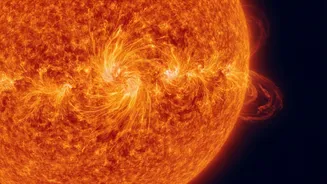
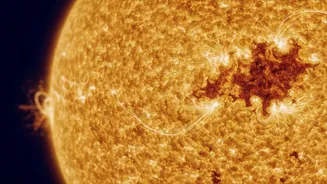
A New, Powerful Eye on Our Star
The latest groundbreaking images come from the Daniel K. Inouye Solar Telescope in Hawaii, the most powerful solar telescope on Earth. Its massive four-meter mirror allows it to collect more sunlight than any other solar instrument, producing images of
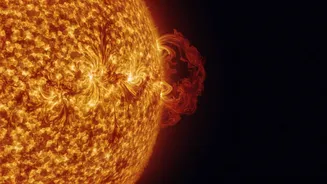
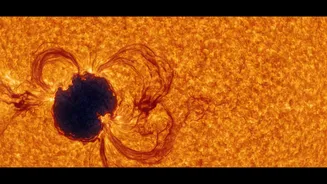
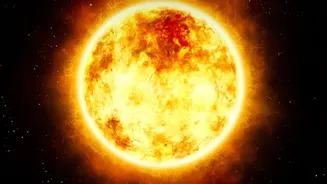
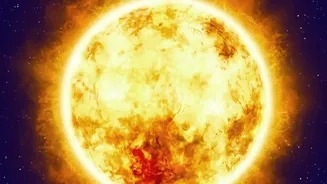
the Sun's surface, or photosphere, with unprecedented resolution. These images can resolve features as small as 20 kilometres across on a star that is nearly 1.4 million kilometres in diameter. This is like seeing a coin from 180 kilometres away. For the first time, scientists are not just seeing the Sun, but the intricate, fine-scale physics playing out on its surface in real-time.
The Science of Solar Swirls
The mesmerising, city-sized swirls seen in the new images are the first direct confirmation of a long-theorised phenomenon known as the Kelvin-Helmholtz instability (KHI). This process occurs in fluids and plasmas when two layers moving at different speeds slide past each other, creating a shear that rolls up into vortices. You can see similar patterns in ocean waves or cloud formations on Earth. On the Sun, these instabilities happen at the edges of solar granules—Texas-sized cells of rising hot plasma and sinking cooler plasma that cover the Sun's surface like a pot of boiling water. The interaction between these fast and slow-moving plasma flows creates the tiny, energetic whirlpools now visible to scientists.
Unravelling Long-Standing Solar Mysteries
Observing these swirls isn't just about capturing a pretty picture; it's about solving fundamental puzzles of solar physics. One of the biggest mysteries is the coronal heating problem: why is the Sun's outer atmosphere, the corona, hundreds of times hotter than its surface? Scientists believe these Kelvin-Helmholtz instabilities could be a key part of the answer. The swirling motion can act like a tiny engine, converting kinetic energy from the plasma flows into magnetic energy. This energy is then transported upwards, potentially breaking down and releasing its heat into the corona. By studying how common and energetic these swirls are, researchers can finally test this theory with direct evidence.
Improving Space Weather Forecasts
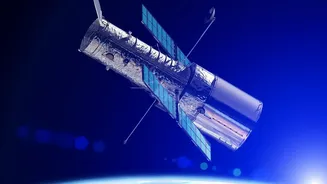
Understanding the Sun’s behaviour has direct consequences for our technology-dependent life on Earth. Explosive events like solar flares and coronal mass ejections (CMEs) are driven by the Sun’s complex magnetic fields. These events can hurl massive amounts of radiation and charged particles toward Earth, threatening satellites, GPS navigation, communication systems, and even power grids. The newly observed swirls are believed to play a role in twisting and tangling the Sun's magnetic field lines, storing energy that can later be released in these violent outbursts. By studying these tiny structures, scientists hope to build more accurate models of solar activity, leading to better predictions of space weather and giving us more time to protect our critical infrastructure from solar storms.