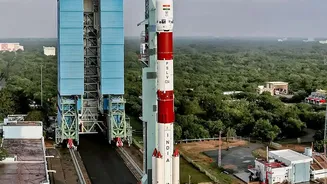







A New Gateway to the Stars
In the coastal district of Thoothukudi, Tamil Nadu, a new chapter for Indian space exploration is being built at a cost of ₹986 crore. The Kulasekarapattinam spaceport, for which Prime Minister Narendra Modi laid the foundation stone in February 2024,
is India’s second major launch site after Sriharikota. But unlike its predecessor, this facility is purpose-built for one thing: launching Small Satellite Launch Vehicles (SSLVs). Its key advantage is geography. Located on India's southern tip, it allows rockets to fly directly south over the Indian Ocean. This eliminates the need for the fuel-intensive 'dog-leg' manoeuvre that rockets from Sriharikota must perform to avoid flying over Sri Lanka, saving fuel and increasing the payload capacity for missions heading into polar orbits.
The Small Satellite Revolution
The focus on SSLVs is a direct response to a booming global market. Small satellites, some no bigger than a shoebox, are in high demand for everything from Earth observation and communications to internet services. The SSLV is ISRO’s answer to this demand—a rocket designed for quick, low-cost, on-demand launches of payloads up to 500 kg. By creating a dedicated spaceport for these smaller rockets, India aims to become a globally competitive hub for small satellite launches. This frees up the Satish Dhawan Space Centre in Sriharikota to focus on ISRO’s larger, more complex missions, like the heavy-lift LVM3, Gaganyaan human spaceflight, and interplanetary exploration.
Private Hands on the Launchpad
In a landmark move, the Indian National Space Promotion and Authorisation Centre (IN-SPACe) has formally invited private companies to take over the complete operation and management of the new launch complex. This is a significant step beyond just allowing private companies to launch their own rockets. The selected private operator will be responsible for end-to-end management, including launch campaign operations, facility maintenance, safety, security, and coordinating with commercial clients. This initiative is the boldest step yet in India's strategy, formalized in the Indian Space Policy 2023, to transition from a government-led space program to a collaborative ecosystem. ISRO will not simply hand over the keys; it will provide technical guidance and training for up to one year or the first three launches to ensure a smooth transition.
The Benefits of a Public-Private Orbit
Handing over the spaceport's operations to a private entity is expected to bring commercial efficiency, foster innovation, and increase the launch frequency. For India's burgeoning private space sector, this is an unprecedented opportunity. It signals that the government is serious about creating an environment where private firms can not only build and launch rockets and satellites but also manage critical national infrastructure. This move is designed to accelerate India’s share of the global space economy, which currently stands at around 2% but is projected to grow significantly. By letting the private sector handle the operational aspects of commercial launches, ISRO can dedicate more of its resources to cutting-edge research and development, pushing the frontiers of space science.
Is Indian Industry Ready for Liftoff?
The Indian private space ecosystem has grown dramatically since the sector was opened to private participation in 2020. Today, there are hundreds of startups working on launch vehicles, satellite manufacturing, propulsion systems, and ground stations. Companies like Skyroot Aerospace and Agnikul Cosmos have already demonstrated their capabilities with private rocket launches and the development of 3D-printed engines. This growing maturity suggests that the industry is ready to take on more significant responsibilities. However, running a spaceport is a complex and capital-intensive endeavour. It requires not just technical expertise but also robust financial backing and stringent adherence to safety protocols. The Expression of Interest issued by IN-SPACe is designed to identify firms with the necessary scale and capability to manage such a vital national asset.