

The Arctic's Cloud Conundrum
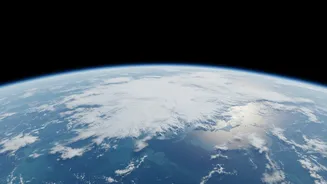
Clouds are one of the biggest wildcards in climate science. Depending on their altitude, thickness, and the surface below them, they can either cool the planet by reflecting sunlight back into space or warm it by trapping heat radiating from the Earth.
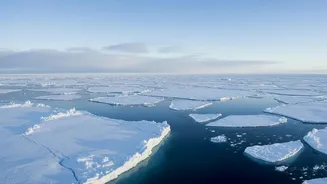
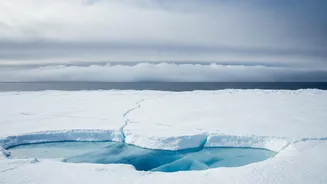
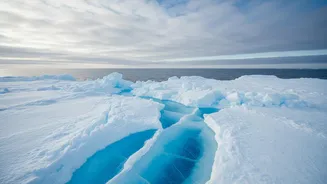
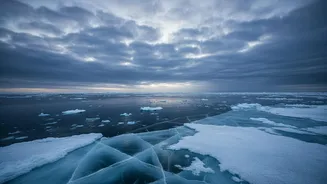
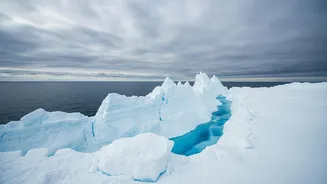
In the Arctic, this duality is especially critical. The region is warming at roughly three times the global average, a phenomenon known as Arctic amplification. As the bright, reflective sea ice melts, it exposes the dark, absorbent ocean beneath, which soaks up more solar energy, leading to more warming and more melting. Scientists have long known that clouds play a pivotal role in this feedback loop, but their exact behaviour has been a source of significant uncertainty in climate models. Do more clouds form over the newly exposed ocean? And if so, do they put the brakes on warming or press the accelerator?
The Seeds of a Cloud
For a cloud to form, water vapour in the atmosphere needs a little something to cling to. These microscopic seeds are called cloud condensation nuclei (CCN), or aerosols. They can be anything from dust and pollution to sea salt spray and, as scientists are now discovering, particles originating from biological activity in the ocean. The pristine summer air of the high Arctic has very few of these particles compared to more populated regions. This has made understanding cloud formation there a unique challenge. Without an abundance of these seeds, how do the extensive low-level clouds that blanket the Arctic come into being? A new study offers a compelling, and previously unseen, answer.
A Breakthrough at the Ice Edge
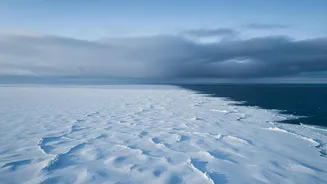
An international research team led by the University of Birmingham has provided the first real-world evidence of a powerful new source of these cloud-seeding particles. Their findings, published in Nature Geoscience, focus on the marginal ice zone—the dynamic boundary where melting sea ice meets the open ocean. Here, a potent combination of factors comes into play. Marine life, like algae thriving in the nutrient-rich water at the ice edge, releases chemical compounds. Specifically, the team found that iodine from the ocean and sea ice, combined with sulphur compounds from marine algae, are released into the air. Under sunlight, these gases undergo a chemical transformation to create new atmospheric particles.
An Explosion of New Particles
The effect is dramatic. During an expedition in 2022 aboard the Royal Research Ship Discovery, the scientists observed that new particle formation occurred on over 80% of sunny days. Near the ice edge, they watched as the number of particles capable of forming cloud droplets surged, in one case rising fifty-fold in a single day. This process, previously only demonstrated in lab experiments at CERN, was now validated in the real world. The team also identified a new class of molecules, called iodine-containing oxygenated organic molecules (I-OOMs), that help these tiny new particles grow large enough to effectively seed clouds. This discovery reveals a powerful, naturally occurring feedback loop: a warming atmosphere melts sea ice, the exposed ice edge promotes biological activity that releases chemicals, and sunlight turns these chemicals into a flurry of cloud-seeding particles.
What This Means for Our Climate
The discovery complicates the picture of Arctic climate change. More clouds during the sunlit summer could potentially cool the open ocean by reflecting sunlight, but they could also trap heat and accelerate the melting of the remaining sea ice. The net effect—warming or cooling—is not yet clear and is a critical question for future research. Because the marginal ice zone is expanding as sea ice retreats, this newly identified cloud-seeding process is likely becoming more widespread and intense. Incorporating this complex iodine-sulphur chemistry into global climate models is a crucial next step. Doing so will improve predictions about the future pace of Arctic warming and its cascading effects on global weather systems, sea-level rise, and the stability of the entire planet's climate.