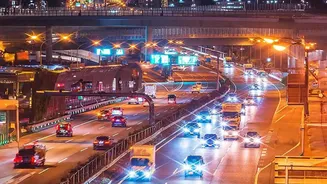










What Is the Intelligent Traffic Management System?
The Union Cabinet has approved a transformative project for Delhi called the Intelligent Traffic Management System (ITMS). With a budget of over ₹1,789 crore, it's an ambitious plan to install a technological 'brain' over the city's road network. The system
has two core components. First, it uses artificial intelligence to give emergency vehicles, like ambulances and fire tenders, priority passage. Second, it establishes a central command system to monitor and manage traffic flow across the city in real-time, moving away from outdated fixed-time signals. The Delhi Police will implement this project, which is scheduled to roll out in three phases over 24 months across 42 key traffic corridors.
How AI Creates a 'Green Corridor'
The most critical feature of the ITMS is its ability to create automated 'green corridors' for emergency vehicles. This is how it will work: ambulances and other designated vehicles will be fitted with special sensors. As the vehicle approaches a traffic intersection, the sensors communicate with the AI-powered traffic signals. The system can detect an approaching emergency vehicle from a range of 200-500 meters. Upon detection, the signal ahead will automatically turn green, clearing the path. It will remain green just long enough for the vehicle to pass through the junction before resuming its normal cycle. This process repeats at each signal along the vehicle's route, creating a seamless and fast-moving corridor that drastically reduces transit time during a crisis.
A Smarter System for All Commuters
While prioritizing ambulances is the headline feature, the ITMS is designed to improve the daily commute for everyone. The system will deploy 1,092 Adaptive Traffic Control Systems across the city. Unlike current signals that run on a fixed timer, these smart signals will use a network of cameras and sensors to analyze live traffic density, vehicle speed, and queue lengths. The AI will then dynamically adjust signal timings to reduce congestion and create 'green waves' for smoother traffic flow. The central command centre will get real-time data on traffic jams, accidents, and slow-moving stretches, allowing for faster diversions and responses. This information will also be relayed to commuters through Variable Message Sign boards and digital navigation platforms.
Automated Enforcement and Enhanced Safety
The ITMS will also usher in a new era of traffic enforcement across 1,029 locations. The network of AI cameras will be capable of automatically detecting a wide range of violations, including red-light jumping, speeding, wrong-way driving, stop-line violations, and the use of mobile phones while driving. It can also identify riders without helmets and drivers without seat belts. The system's AI analytics will be integrated with databases like VAHAN to identify stolen or blacklisted vehicles and track repeat offenders or those involved in hit-and-run incidents. This move towards technology-based enforcement aims to improve road discipline and overall safety on Delhi's streets.
The Road Ahead and Potential Challenges
The project will be implemented corridor-wise, with the first phase covering five major corridors within the first 12 months. The entire project, covering 42 corridors, is slated for completion in 24 months, followed by a five-year period of operation and maintenance. While the system holds immense promise, its success will depend on seamless execution. Challenges include ensuring the hardware and software are robust and reliable, integrating the new technology with existing infrastructure, and maintaining the vast network of sensors and cameras. The project's implementation is performance-driven, meaning each phase must meet strict testing and performance criteria before the next one begins, ensuring a gradual and effective rollout.