






From Theory to Reality
For years, the Gaganyaan mission has been a story of design, component development, and simulations. Now, the Indian Space Research Organisation (ISRO) is shifting gears into a more hands-on, integrated phase. This means moving beyond testing individual
parts in labs and starting to test how multiple systems work together in real-world scenarios. It’s the difference between building a car engine and taking the whole car for a spin. This practical phase is all about ensuring every piece of the complex puzzle, from launch to landing, fits together perfectly and, most importantly, safely.
A New Rocket for a New Task
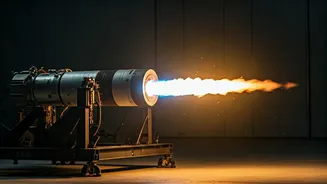
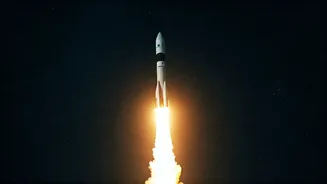
A key part of this new phase is the development of a dedicated test rocket called SOLVE, or Sub-Orbital Launch Vehicle for Experiments. On July 3, 2026, ISRO successfully conducted the first ground test of the solid motor that will power this vehicle. SOLVE is ingeniously derived from the strap-on boosters of the reliable PSLV rocket but has been modified for a special purpose. Instead of going to orbit, it will carry the Gaganyaan Crew Module to an altitude of 10 to 17 kilometres and release it. This will allow engineers to repeatedly test the module's crucial re-entry and landing systems under a wide range of simulated conditions, a critical step in ensuring astronaut safety.
The All-Important Parachutes
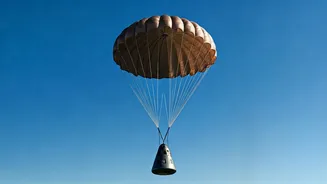
One of the most critical systems being validated is the parachute-based deceleration system, which is essential for slowing the crew module for a safe splashdown in the sea. The system is complex, involving a sequence of 10 different parachutes. Recent tests, including the Integrated Air Drop Test (IADT), have been designed to validate this entire sequence. In these tests, a dummy crew module is dropped from a helicopter to verify that the parachutes deploy correctly and slow the capsule to a safe landing speed. ISRO even simulates failure scenarios, such as one main parachute failing to open, to ensure the system is robust enough to handle emergencies.
Safety is the Highest Priority
Every test in this practical phase is designed with one ultimate goal: the safety of the Vyomanauts, India's astronaut-designates. The mission aims to send a three-member crew into a 400-km low-Earth orbit for a three-day mission and bring them back safely. Before that can happen, ISRO must prove the reliability of every system. This includes not just the parachutes, but also the Crew Escape System, which would pull the astronauts to safety in case of a launchpad emergency, and the life support systems inside the capsule. To this end, ISRO has already conducted over 8,000 tests for the Gaganyaan programme.
The Road Ahead
The successful ground test of the SOLVE motor and various parachute drop tests are major milestones. The next steps involve using SOLVE for in-flight tests of the crew module. Following that, ISRO plans for a series of uncrewed test flights before the first crewed mission. The first uncrewed launch, G1, will send a humanoid robot named Vyommitra into orbit to validate all systems in a real space environment. While timelines in space exploration are always subject to change, each successful test brings India one step closer to joining the elite club of nations with independent human spaceflight capability. The target for the first crewed mission is currently set for 2027.