





A Prime Target for Alien Life
Enceladus is one of the most compelling places in our solar system to search for extraterrestrial life. Beneath a thick crust of ice lies a global ocean of liquid saltwater, kept warm by heat from the moon's core. What makes Enceladus truly special are
the massive plumes of water vapour and ice particles that erupt from deep fractures near its south pole, nicknamed 'tiger stripes'. These geysers shoot material from the subsurface ocean hundreds of kilometres into space. This phenomenon gives scientists an incredible opportunity: a way to sample an alien ocean without having to land and drill through miles of ice. Data from NASA’s Cassini mission, which flew through these plumes, has already confirmed the presence of water, salts, and organic compounds—the essential ingredients for life as we know it.
Nature's Concentration Game
Detecting faint signs of life, or biosignatures, in these plumes is a monumental challenge. If life exists, its chemical fingerprints might be incredibly diluted within the vast ocean. However, recent studies published in Science Advances reveal that Enceladus may be doing some of the hard work for us. Researchers now believe that as droplets of ocean water rise through the cracks in the ice, they freeze slowly. This slow freezing process causes different chemical compounds, like salts and organics, to separate and become concentrated in distinct parts of the frozen droplet. These larger droplets then shatter into smaller ice grains before erupting into space, with each grain potentially carrying a highly concentrated payload of a specific compound.
Finding the Needle in the Haystack
This natural sorting mechanism is a game-changer for astrobiology. It means that instead of searching for a molecule that is barely detectable in the overall ocean, a spacecraft could find it highly concentrated in just a few individual ice grains. According to Fabian Klenner, a researcher involved in the studies, this suggests that molecular signatures of life, if they exist, might be found in only a small fraction of the grains. Laboratory experiments have confirmed this theory, showing that even a tiny amount of cellular material from certain bacteria could be identified by a mass spectrometer in a single ice grain. This makes the task of finding life less like searching for a single needle in an enormous haystack and more like looking for a few very shiny needles.
Built to Survive the Journey
Another critical question was whether delicate organic molecules, like the amino acids that form proteins, could even survive the violent ejection into space. The plumes from Enceladus spew ice grains at speeds of around 800 miles per hour. Until recently, scientists worried that the impact of these grains on a spacecraft's detector would obliterate any complex molecules within them. However, a separate laboratory study provided definitive evidence that amino acids can withstand these high-velocity impacts, remaining largely intact and detectable. This finding provides more confidence that the biosignatures launched from Enceladus’ ocean would be readable by the time they reached a passing probe.
Informing Future Missions
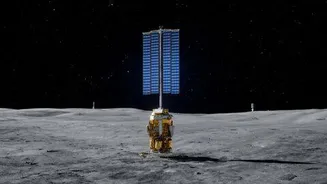
These collective discoveries are not just theoretical; they have profound implications for future missions designed to hunt for life on Enceladus. Knowing that biosignatures might be concentrated in specific grains tells engineers that future probes must be equipped with instruments capable of analysing a large number of individual ice particles, rather than just averaging the composition of the whole plume. Proposed missions like NASA's 'Enceladus Orbilander' or Europe's 'L4 Enceladus Mission' are being designed with these insights in mind. These ambitious projects would orbit the moon, making multiple flights through its plumes to collect and analyse fresh material before potentially landing on the surface.