






A World Forged by Gravity
Io is a world caught in a cosmic tug-of-war. Its slightly elliptical orbit means it is constantly being stretched and squeezed by the immense gravity of Jupiter on one side and two of its other large moons, Europa and Ganymede, on the other. This relentless
gravitational flexing, known as tidal heating, generates tremendous friction and heat deep within the moon's interior. This internal furnace is the engine that powers Io's more than 400 active volcanoes, which spew lava and sulphur compounds across its surface, burying impact craters and creating a landscape unlike any other. For decades, scientists could only study the heat escaping from the surface through infrared observations, getting a snapshot of the moon's skin temperature.
Juno's Unexpected Toolkit
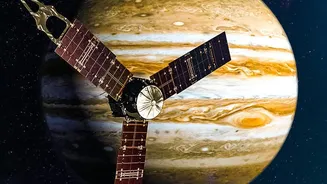
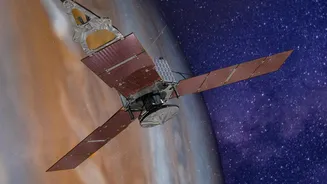
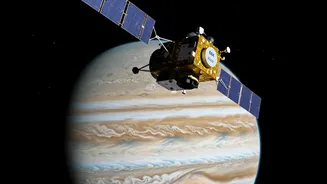
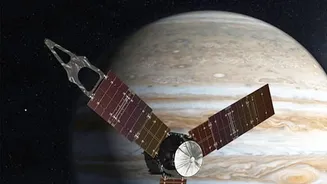
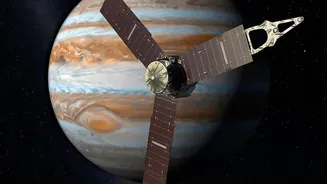
Enter the Juno spacecraft. Launched in 2011 to study Jupiter itself, its mission was extended to include close flybys of the planet's fascinating moons. During two daring passes in late 2023 and early 2024, Juno came within about 1,500 kilometres of Io's surface. Scientists repurposed one of Juno's key instruments, the Microwave Radiometer (MWR), which was originally designed to peer through Jupiter's thick atmosphere. They gambled that it could also penetrate the rocky surface of Io. The gamble paid off spectacularly, allowing them to probe depths from a few inches down to several meters for the first time.
Peeling Back the Frosty Layer
The data sent back by the MWR was stunning. Everywhere the instrument looked, it found the temperature rising significantly just a short distance beneath the surface. In some areas, the temperature jumped by more than 22 degrees Celsius only a few feet down. This steep thermal gradient is far greater than what could be explained by heating from the sun alone. It was a clear sign that Io is leaking a tremendous amount of heat from its interior, not just through its spectacular volcanoes, but seemingly everywhere across its surface. The microwave data also revealed another surprise: much of Io's surface is remarkably smooth and made of a low-density, porous material, likely layers of volcanic ash and sulphur frost built up over eons of eruptions.
The Magma Ocean Debate
These findings have reignited a long-standing debate about what lies beneath Io’s crust. Does the moon have a single, global ocean of magma? Or is the magma confined to smaller, more localised pockets that feed individual volcanoes? The widespread heat flow detected by Juno could support the idea of a conductive crust sitting atop a vast magma reservoir. However, more recent analysis of Juno's data on Io's tidal deformation—how much it physically bulges—suggests its interior is more solid than a global magma ocean would allow. The current thinking is leaning towards a solid mantle with many separate, localised magma chambers. Juno's findings provide crucial data points that will help scientists refine their models and get closer to solving this fiery mystery.
Why This Fiery Moon Matters
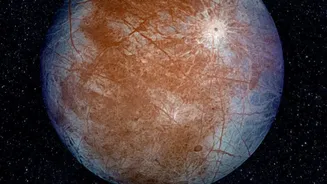
Studying the extreme case of Io helps us understand a fundamental process that shapes worlds across the cosmos: tidal heating. This same mechanism is thought to maintain liquid water oceans beneath the icy shells of other moons like Europa and Saturn's Enceladus, which are prime candidates in the search for extraterrestrial life. Furthermore, the unexpected success of using a microwave radiometer to see beneath a rocky moon's surface opens up new possibilities for studying volcanoes, not just on other worlds, but also here on Earth. As Juno's principal investigator Scott Bolton noted, a similar instrument could potentially reveal new information about how our own planet's volcanoes work.