




The Language of Stone and Strategy
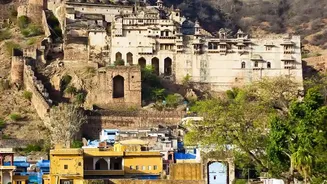
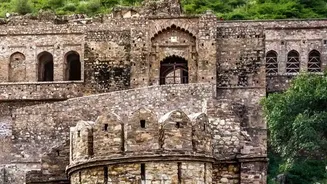
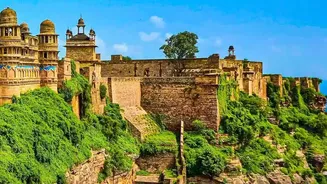
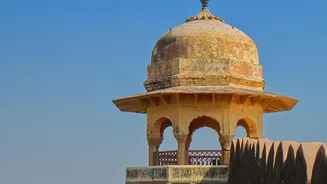
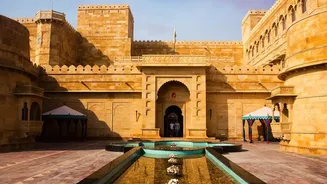
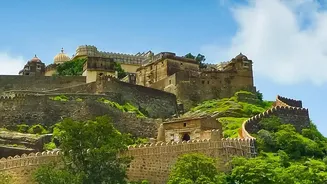
Across India, forts are the grand storytellers of the landscape. They were never just defensive structures; they were the epicentres of power, culture, and life itself. Their designs were a language. Massive ramparts, often rising hundreds of feet, were a clear
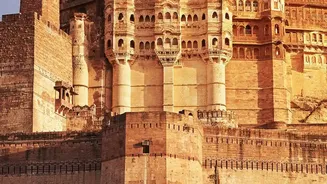
statement of power and defiance, with some walls at Mehrangarh Fort reaching 120 feet high and 70 feet thick. Within these formidable walls, life thrived. Expansive courtyards hosted festivals and royal courts, while intricate palaces became sanctuaries for art, music, and literature. These spaces were not afterthoughts but deliberate expressions of a ruler's legacy, blending military necessity with cultural aspiration. The very placement of a fort, whether on a hill (Giri Durg) or by water (Jala Durg), was a strategic choice rooted in ancient texts like the Arthashastra.
Mehrangarh: The Sun Fort's Grandeur
Perched on a rocky hill 400 feet above Jodhpur, Mehrangarh Fort seems to grow out of the very rock it commands. Founded in 1459 by Rao Jodha, its name means 'fort of the sun', a nod to the Rathore clan's mythical solar lineage. The fort tells a story of both might and sacrifice. As you pass through its seven monumental gates, you can still see the marks of cannonball impacts from centuries of battles. Inside, the narrative shifts from war to wonder. Palaces like the Moti Mahal (Pearl Palace) and Sheesh Mahal (Mirror Palace) reveal the delicate artistry of Rajasthani craftsmen, with intricate carvings and expansive courtyards that stand in stark contrast to the intimidating exterior. It’s a place that Rudyard Kipling aptly described as looking like it was “built by Titans and colored by the morning sun.”
Amer Fort: Where Royalty Met Artistry
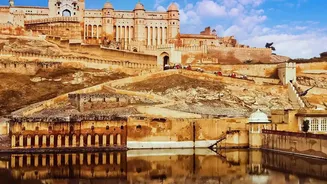
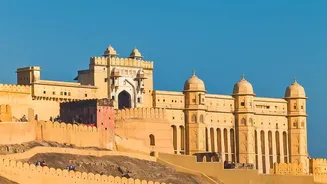
Overlooking Maota Lake near Jaipur, Amer Fort tells a tale of synthesis and splendour. Built from red sandstone and marble, it is a masterful blend of Rajput and Mughal architectural styles, a testament to the political alliances of its time. Commissioned by Raja Man Singh I in 1592, the fort unfolds in a series of four magnificent courtyards. The story here is one of royal life in all its facets. The Diwan-i-Aam, or Hall of Public Audience, speaks of governance and justice. Further in, the legendary Sheesh Mahal (Palace of Mirrors) narrates a story of opulence and ingenuity. Thousands of tiny mirrors embedded in its walls and ceiling could illuminate the entire chamber with the light of a single flame, creating a galaxy of stars for the royalty within. Clever engineering is also seen in chambers like the Sukh Niwas, where a channel of running water created a natural form of air conditioning.
Golconda: The Echo of Diamonds
The story of Golconda Fort in Hyderabad is one of incredible wealth and brilliant engineering. Once a simple mud fort, it was transformed by the Qutub Shahi dynasty into a fortified capital that became the heart of the world's diamond trade. It is believed that legendary gems like the Koh-i-Noor and the Hope Diamond were once stored and traded here. But Golconda’s story is also told through sound. The fort is an acoustic marvel; a clap at the main gate, the Fateh Darwaza, can be heard clearly at the highest point of the citadel nearly a kilometre away. This was no accident, but a sophisticated warning system built into the very fabric of the palace. The fort’s ruined palaces, mosques, and ingenious water systems tell a grand story of a kingdom that flourished on unimaginable riches before its eventual fall to the Mughals.