





Cosmic Spotlights and Their Tiny Cousins
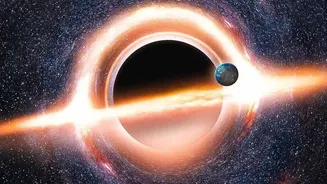
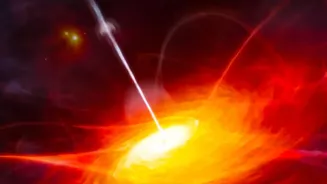
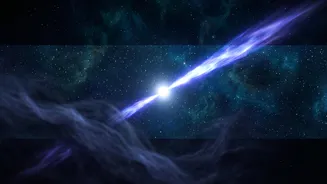
To understand the excitement, we first need to talk about blazars. Imagine a galaxy with a supermassive black hole at its centre, millions or billions of times the mass of our Sun. As this cosmic engine devours gas and stars, it can blast out colossal
jets of particles at nearly the speed of light. If one of these jets happens to be pointed directly at Earth, we see a 'blazar'—an object that appears incredibly bright and energetic. For years, scientists predicted that a smaller version should exist: a 'microblazar'. This would involve a much smaller, stellar-mass black hole in our own galaxy, doing the same thing on a smaller scale. Finding one, however, proved to be a major challenge.
The Puzzle of IRAS 18293-0941
Enter IRAS 18293-0941, an object located about 12,000 light-years away in the Milky Way. For over 30 years, it was a source of mystery, hidden behind thick clouds of interstellar dust. Observations showed it had properties that made it a compelling candidate for a microblazar. It's a binary system where a black hole, about ten times the mass of our Sun, is pulling material from a massive companion star. Radio telescope data revealed a jet of particles shooting out from the system, seemingly aimed right in our direction. This 'one-sided' jet is a classic sign of relativistic beaming, where the light from an object moving towards us is dramatically amplified, making it look like a cosmic spotlight is shining on us.
A Galactic Particle Accelerator
The latest research, however, refines this picture. The headline's 'fast particle beam' isn't from a distant galaxy impersonating IRAS 18293-0941. Instead, the system itself is the source. The stellar-mass black hole is generating a powerful jet that is travelling at about 75% of the speed of light. This jet isn't just flying through empty space. In one direction, it's aimed towards Earth, which is why we classify it as a microblazar candidate. In the other direction, the jet is slamming into a dense molecular cloud. This collision is what creates such a fascinating phenomenon. The jet acts as a powerful particle accelerator, energizing the cloud and causing it to glow in high-energy radiation like gamma rays.
How Scientists Connected the Dots
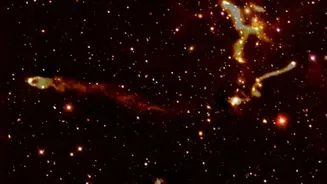
Confirming this required a global effort, using an array of powerful telescopes. Researchers combined data from the European Very Long Baseline Interferometry Network, the MeerKAT radio telescope in South Africa, and the Very Large Array in the United States, among others. By observing the object across different wavelengths—from radio waves to gamma rays—they pieced together a complete picture. The radio observations mapped the jet's structure, showing it ploughing through interstellar gas for nearly 100 light-years before hitting the cloud. This provided a clear link between the black hole system (the engine) and the high-energy glow from the distant cloud (the target).
Why This Discovery Is a Big Deal
The confirmation of IRAS 18293-0941 as our galaxy's first microblazar is significant for several reasons. Firstly, it provides a 'local' laboratory to study processes that were previously only observable in blazars billions of light-years away. Scientists can now get a much more detailed look at how black hole jets form and transfer energy to their surroundings. Secondly, it helps solve a long-standing mystery about the origin of some of the most energetic particles in our galaxy, known as cosmic rays. This system is a natural particle accelerator, capable of producing energies 100 times greater than the Large Hadron Collider on Earth. While the jet is pointed in our general direction, at 12,000 light-years away, it poses no danger to our planet.