





The Ghost of an Ocean
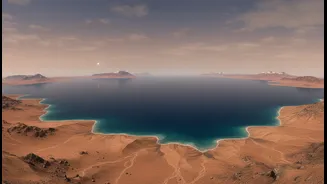
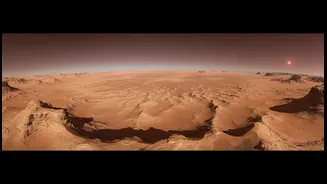
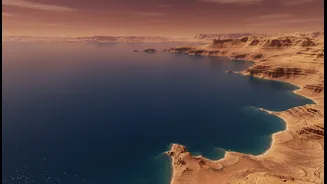
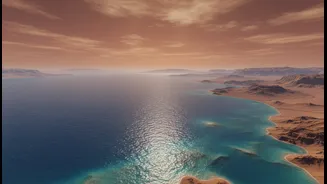
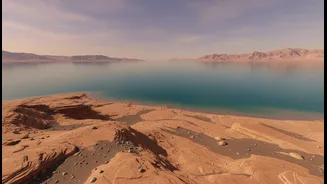
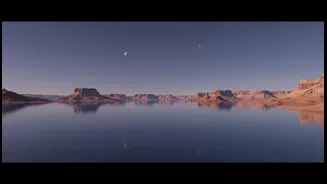
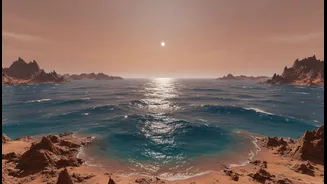
For decades, the scientific community has debated whether Mars once hosted a massive ocean in its northern hemisphere. Evidence from rovers and orbiters has clearly shown that liquid water once flowed on the planet, carving out rivers and pooling in lakes.
However, the jump from localised water to a planet-defining ocean has been a difficult one to prove. Previous studies identified features that resembled shorelines, but these were often at inconsistent elevations, casting doubt on the theory of a single, massive body of water. The question remained: was Mars a planet with a few lakes, or was it once a blue world, similar to our own?
A New Map for an Old Planet
Instead of looking for subtle, easily eroded shorelines, a team of researchers decided to search for a more robust geological feature. They theorised that if an ocean existed for millions of years, it would leave behind a feature analogous to the continental shelves we see on Earth. Using topographical data from NASA's Mars Global Surveyor orbiter, the scientists essentially looked for a large, stable 'bathtub ring'—a distinct boundary marking where the water level once met the land. This approach shifted the focus from a delicate line in the sand to a massive, more permanent geological signature that would be harder to erase over billions of years of wind and erosion.
The Tell-Tale Coastal Shelf
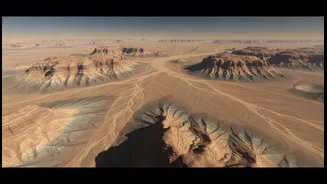
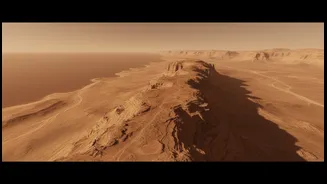
The search paid off. By analysing the detailed elevation maps, researchers identified a wide, deep band of land that strongly suggests the presence of a coastal shelf. This feature, which wraps around the northern lowlands, is consistent with the kind of structure that forms over long periods as rivers dump sediment into an ocean and waves distribute it. The team noted that this type of large-scale formation is not typically found around smaller lakes, suggesting the body of water was vast and long-lived. Some estimates suggest this ancient ocean could have covered about a third of the Martian surface, roughly equivalent in area to 13% of Earth's oceans.
Connecting the Dots for a Wetter Mars
This discovery provides a powerful new piece of evidence that Mars once had an active hydrological cycle around 3.7 billion years ago, with rivers flowing into a massive northern ocean. The existence of a long-lived ocean dramatically changes our understanding of the planet's ancient climate. It would have required a much thicker atmosphere and warmer temperatures to keep so much water in a liquid state. Most importantly, the presence of a stable, long-lasting body of water significantly increases the chances that Mars could have once harboured life. Coastal sediments on Earth are excellent at preserving fossil records, and these newly identified Martian shelves could be prime targets for future missions searching for signs of ancient biology.
The Next Wave of Research
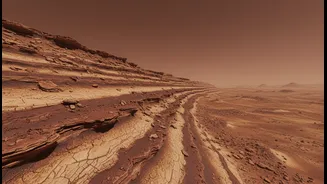
While this finding is a significant step forward, researchers caution that more work is needed. The claim will need to be scrutinized and verified by other scientists using different datasets and methods. Future analysis of satellite data will continue, but the ultimate confirmation may have to wait for a rover to visit these proposed coastal deposits. Such a mission could analyse the sedimentary rocks for the tell-tale layering and textures produced by waves and currents, confirming their oceanic origin. The new research provides a compelling roadmap for where to send those future robotic explorers to get a definitive answer to one of the biggest questions about the Red Planet.