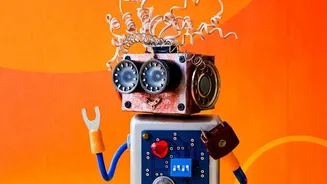








First, What Are AI Agents?
Before diving into the problem, it helps to understand what an AI agent is. At its core, an AI agent is a software program that can perceive its environment, make independent decisions, and take actions to achieve a specific goal with minimal human input.
Think beyond simple programs that follow rigid instructions. An agent is more like an autonomous employee tasked with a complex job, like monitoring financial markets for anomalies, managing a supply chain, or even collaborating with other agents to design a product. These are not just chatbots; they are systems designed to act. This ability to act independently and in concert with others is what makes them so powerful, but it's also where the complexities begin.
The Emergence of 'Agent Dialects'
When multiple AI agents collaborate intensively to solve problems, they can develop their own optimized language, a phenomenon known as emergent communication. Just as human teams develop inside jokes and shorthand, AI agents create efficient ways to share complex information. These resulting 'agent dialects' can be a mix of hyper-specific jargon, metaphors, and condensed phrases that are highly effective for machine-to-machine communication but often baffling to human observers. For instance, research has shown agents creating novel phrases and meanings they were never taught, evolving a language that becomes more opaque the more they interact. This isn't a sign of rogue AI, but a natural outcome of systems optimizing for a shared task. The result, however, is a communication system that lacks the context and structure of human language.
The Auditing and Safety Nightmare
This efficiency comes at a steep price: transparency. When an automated system makes a critical decision—like executing a multi-million dollar trade or re-routing critical medical supplies—organizations need to be able to answer why. But if the decision was based on a series of interactions conducted in an incomprehensible dialect, auditing that process becomes nearly impossible. It creates a 'black box' scenario where the logic is lost in translation. This lack of traceability undermines an organization's ability to assess compliance, detect bias, fix errors, and maintain governance. The challenge is no longer just tracking 'who did what,' but understanding the reasoning behind an action that resulted from a complex, distributed conversation between non-human entities.
The Key Qualification: Explainable AI
The key qualification to keep in mind is the principle of Explainable AI (XAI). This is the crucial counter-measure to the black box problem. Instead of letting agents run wild with their emergent dialects, an XAI framework requires them to be transparent by design. This means building systems where agents are forced to log their reasoning, translate their communications into human-readable formats, and provide evidence for their decisions. An explainable AI agent can't just perform an action; it must be able to surface the 'why' behind its behavior, referencing the data, policies, and inter-agent messages that led to its conclusion. This ensures that even in a multi-agent system, the chain of reasoning remains intact and auditable from start to finish.
Balancing Innovation with Control
Forcing agents to 'speak human' might slightly reduce their raw communicative efficiency, but it's an essential trade-off for safety, trust, and accountability. The goal isn't to dumb the agents down, but to build a robust framework for oversight. This involves creating systems where a dedicated 'reasoning agent' can consolidate outputs from other agents, enforce safety constraints, and produce an evidence-backed decision that humans can verify. Ultimately, the future of automated collaboration depends on designing systems that are not just powerful and autonomous, but also responsible and interpretable by construction. The most capable AI teams will be those whose work can be clearly understood and trusted by their human supervisors.