







A New Era of Seeing the Earth
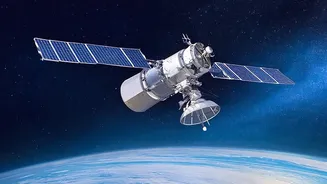
What was once the stuff of spy thrillers is now a commercial reality. Companies are deploying hundreds of small satellites into low-Earth orbit, creating constellations that can image the same spot on Earth multiple times a day. This is a dramatic shift
from the past, when obtaining satellite imagery might involve waiting days or weeks. The result is a near-real-time view of the planet, with resolutions so high they can capture details down to less than a metre. This surge in private activity is driven by falling launch costs and miniaturised technology, turning Earth observation into a booming commercial market. By 2026, Earth observation has evolved from a niche scientific field into a cornerstone of global decision-making for businesses and governments alike.
The AI Brain That Processes It All
This firehose of data—hundreds of terabytes daily—would be useless without a way to make sense of it. This is where artificial intelligence becomes the engine of Earth observation. AI and machine learning algorithms are now essential for automatically analysing satellite imagery, detecting patterns, tracking changes, and extracting insights with incredible speed and accuracy. These AI models can identify everything from new construction and deforestation to crop health and vehicle movements, turning raw pixels into actionable intelligence. Some advanced satellites even have AI processors on board, allowing them to analyse data in orbit before sending it back to Earth, making the process even faster.
Incredible Benefits for Planet and Profit
The applications for this technology are transforming industries and aiding humanity. In agriculture, it helps farmers with precision planting and resource management. For supply chains, it allows companies to monitor for deforestation and comply with sustainability regulations. In the energy sector, it's used for site selection and monitoring infrastructure like pipelines. The technology is also critical for disaster response, providing rapid damage assessments after floods or wildfires to help save lives and speed up recovery. Environmental monitoring has also seen a huge boost, with satellites tracking polar ice melt, air and water quality, and biodiversity.
The Governance and Privacy Black Hole
This powerful new capability comes with significant governance challenges. The sheer number of satellites is creating unprecedented orbital congestion, increasing the risk of collisions and space debris. Furthermore, the laws governing space were written during the Cold War, when only nations were major players. These treaties, like the 1967 Outer Space Treaty, hold nations responsible for all space activities originating from their territory, including private ones. However, they offer little specific guidance on issues like data privacy, orbital traffic management, or the ethical use of high-resolution, persistent surveillance. Questions are mounting about who is liable when an AI-powered satellite makes an autonomous decision that causes harm or violates privacy.
The Search for 21st-Century Rules
The international community is grappling with how to adapt. The UN's Committee on the Peaceful Uses of Outer Space (COPUOS) and the International Telecommunication Union (ITU) are central to these discussions, but progress is slow. The core issue is balancing the immense commercial and societal benefits against risks to security, privacy, and the long-term sustainability of space operations. Some experts are calling for new treaties or major updates to existing ones to specifically address the role of private actors and AI. There are growing concerns about the potential for misinterpretation of satellite data or its use in disinformation campaigns, which could erode public trust. As private companies race to build out their orbital infrastructure, regulators on the ground are struggling to keep pace, creating a governance vacuum for one of the most powerful technologies of our time.