







A Subdued Global Picture
According to the latest “Global Outlook: Running Hot, Running Cold” report from Moody’s Analytics, the world economy is set to expand by a modest 2.5% in 2026, with a slight uptick to 2.8% in 2027. While this avoids a recession, these figures are significantly
below the 3%-plus growth the world is capable of, signaling a period of weaker demand, tighter financial conditions, and persistent uncertainty. This slowdown is not a uniform trend but rather the average of vastly different economic stories playing out across the globe.
The Great Economic Divide
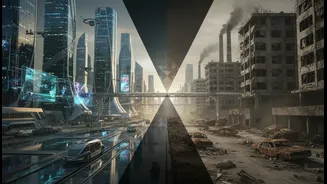
The core of Moody's forecast is the idea of a “K-shaped” recovery, where different parts of the economy move in opposite directions. The driving force behind the 'up' stroke of the K is a boom in Artificial Intelligence. A surge in demand for AI has spurred massive investment in data centres and semiconductors, lifting the technology-heavy economies of Asia and boosting equity markets. On the other hand, the 'down' stroke represents economies and industries less connected to the AI boom. These sectors are struggling under the weight of geopolitical conflicts, trade disruptions, and higher business costs, creating a world economy running at two different speeds.
India: A Relative Bright Spot
Amidst the global slowdown, India is poised to remain a significant outlier. Moody's projects that India will continue to be the fastest-growing major economy in both 2026 and 2027. This places the nation's growth trajectory comfortably ahead of other major economic blocs. For comparison, the United States is forecast to average 2% growth, while China's growth is expected to slow to 4.2% by 2027. The Euro area is predicted to expand by a mere 0.8% in 2026. However, the report cautions that India is not entirely immune to global headwinds. Moody's notes that as the rest of the world moderates, India “will lose a step, too,” suggesting that while its growth is comparatively strong, it will still feel the effects of a cooler global economic climate.
Headwinds and Headaches
The forecast is not without its perils. Moody's highlights several significant risks that could easily tip the slow-growth scenario into a sharper downturn or even a recession. Geopolitical tensions, particularly conflict in the Middle East, remain a primary concern, with the potential to drive up energy prices and fuel inflation. Furthermore, ongoing trade friction between the US and its partners, coupled with stretched asset valuations and volatility in financial markets, creates a fragile environment. These risks threaten to disrupt supply chains, increase costs for businesses, and dampen consumer and investor confidence globally, posing a challenge for every economy, including India.