





A New Team in Orbit
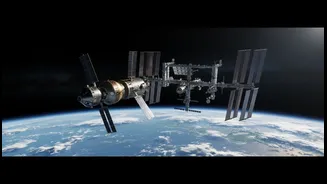
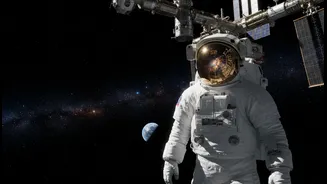
On Tuesday, July 14, 2026, NASA astronaut Anil Menon and his Roscosmos crewmates, Pyotr Dubrov and Anna Kikina, successfully docked with the International Space Station (ISS) after launching from the Baikonur Cosmodrome in Kazakhstan. Their Soyuz MS-29
spacecraft completed a swift three-hour journey before linking up with the station, bringing the total number of occupants to ten for a brief period. The new arrivals were greeted by the seven members of the existing Expedition 74 crew. Menon, Dubrov, and Kikina are slated to spend the next eight months living and working 400 kilometres above Earth, a mission scheduled to conclude in April 2027. This crew rotation marks another chapter in the continuous human presence on the ISS, a global collaboration dedicated to scientific discovery.
Unlocking Biological Secrets
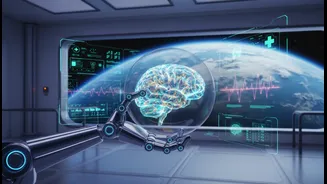
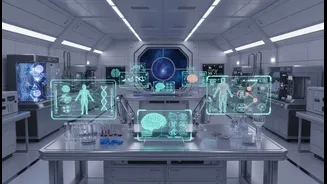
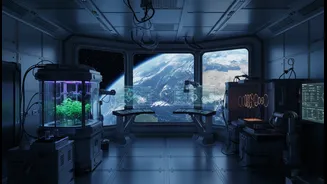
A significant portion of the crew's work will focus on biology and human health, using the unique microgravity environment to study processes that are difficult to isolate on Earth. Menon will be both a researcher and a test subject for several investigations. One key area is understanding how microgravity affects blood flow, which is crucial for protecting astronauts on long-duration missions to the Moon and Mars. He will also work on experiments involving bioprinting vascular structures, a technology that could improve our understanding of the aging process and advance therapeutic developments on Earth. Other ongoing biological research on the station includes studies on how cartilage tissues grow in space, which could lead to advanced treatments for joint injuries, and how plants adapt to the stresses of spaceflight, potentially paving the way for more resilient crops on our planet.
New Frontiers in Physics and Materials
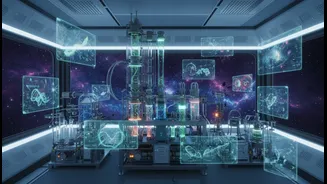
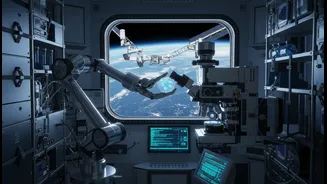
The ISS serves as a one-of-a-kind physics laboratory where the rules of gravity don't apply in the same way. This allows scientists to explore the fundamental properties of materials and fluids. During his mission, Menon will continue research into the in-space production of semiconductor crystals. Growing crystals in microgravity can result in larger and purer structures than possible on Earth, which is essential for developing components for high-performance computers and artificial intelligence. The crew also oversees experiments in fluid physics, studying how liquids behave without the pull of gravity. These findings could lead to more efficient spacecraft systems and even new clean energy solutions on Earth. The absence of gravity allows for breakthroughs in material science that could lead to new alloys and medicines.
Developing Technology for Deep Space
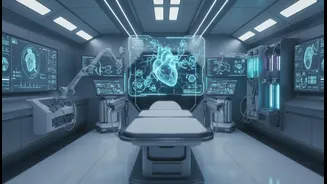
Beyond pure science, the new crew will test technologies critical for humanity's next giant leap into the solar system. One experiment involves using augmented reality and AI to guide astronauts performing ultrasounds, a technique that could one day make deep-space crews medically autonomous without direct support from Earth. They will also work with systems designed to improve life support, such as generating intravenous fluids from potable water and testing more efficient methods for food production, like cultivating spirulina algae. This technology is not just about keeping astronauts safe on the ISS; it's about building the sustainable, self-sufficient systems that will be necessary for long-term habitats on the Moon and extended missions to Mars.