








The Nolan Standard: Bigger is Better
When you watch a Christopher Nolan film, you’re not just seeing a movie; you're having an experience. The director is a passionate advocate for practical effects and, most importantly, large-format film. He believes that shooting on actual film, rather
than digitally, captures a level of detail and immersion that digital cameras can't match. For his new film 'The Odyssey', an adaptation of Homer's epic poem, Nolan has taken this philosophy to its absolute limit. The entire movie was shot using 15/70mm IMAX cameras, a first for any feature film in history. This format, which uses a massive film negative that runs horizontally through the camera, captures an image with staggering clarity and a unique, almost square-like aspect ratio of 1.43:1. The goal, as Nolan has stated, is to make the screen disappear, completely filling the audience's field of vision and creating an unparalleled sense of immersion.
Why IMAX 70mm Film is the Gold Standard
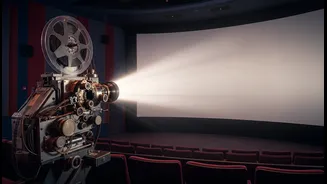
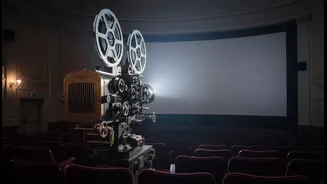
So, what makes this format so special? The term 'IMAX' is used quite broadly today, but not all IMAX is created equal. The majority of theaters branded as IMAX use digital projection systems, which are a significant step up from a standard screen but don't match the director's preferred format. Many of these have been dubbed "LieMAX" by fans for using smaller screens and lower-resolution 2K digital projectors. The true, gold-standard experience Nolan champions is 15/70mm film projection. The '15/70' refers to the 70mm film stock, with each frame being 15 perforations wide—nearly nine times the size of a standard 35mm film frame. This massive negative size is equivalent to a digital resolution of up to 18K, offering breathtaking sharpness and depth. When projected onto a true IMAX screen, which can be as tall as an eight-story building, the image expands to fill the entire screen from floor to ceiling. This is what creates the unique 1.43:1 aspect ratio, showing audiences everything the camera captured.
The World's Most Exclusive Cinemas
This brings us to the headline's claim. Because of the cost and complexity of maintaining the enormous film projectors, only a very small number of theaters worldwide are equipped to project in 15/70mm. The number hovers at around 41 to 45 globally. These venues are a mix of science museums and a handful of commercial cinemas that have preserved the technology. For the release of 'The Odyssey', IMAX reportedly refurbished and installed additional projectors to meet demand, but the number remains incredibly small compared to the thousands of cinema screens worldwide. This exclusive list includes iconic venues like the BFI IMAX in London, the TCL Chinese Theatre in Hollywood, and the AMC Lincoln Square in the New York. The vast majority of the over 1,800 IMAX screens around the world simply cannot project the film on 70mm. This scarcity has turned screenings into major events, with tickets often selling out months in advance.
The Indian Experience: Close, But No 70mm
For cinephiles in India, the news is unfortunately disappointing. As of 2026, there are no commercial theaters in India equipped to project 15/70mm IMAX film. While India once had several such screens in cities like Mumbai and Hyderabad in the 2000s, they have since been closed or converted to digital formats due to high maintenance costs. One true 70mm IMAX projector does exist at the Gujarat Science City in Ahmedabad, but it is used for educational documentaries, not commercial films like 'The Odyssey'. However, that doesn't mean Indian audiences can't have a fantastic experience. The next best thing is IMAX with Laser, specifically a GT Laser system, which uses dual 4K laser projectors capable of preserving the full 1.43:1 aspect ratio. Venues like Miraj IMAX in Mumbai, located at the site of India's first IMAX, and PVR Palazzo in Chennai with its laser projection, offer the largest and highest-quality presentations available in the country, providing an excellent alternative to see Nolan's epic vision on the biggest screen possible.