



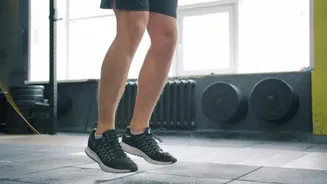
What Exactly Is Shadow Boxing?
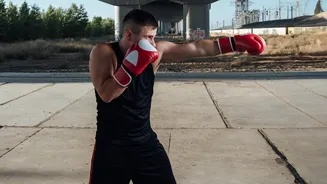
At its core, shadow boxing is a solo exercise where you practice all the movements of boxing—punches, defensive moves, and footwork—without a punching bag or partner. Used by professional fighters and fitness beginners alike, it's a foundational drill
that combines technique with a demanding workout. You move as if you are facing a real opponent, allowing you to focus purely on your form, speed, and movement without the distraction of making contact. This makes it an incredible tool for building a mind-body connection while getting your heart rate up.
An Elite Cardiovascular Engine
One of the most significant benefits of shadow boxing is its impact on your cardiovascular health. The constant movement, from quick footwork to explosive punching combinations, functions like high-intensity interval training (HIIT). This sustained aerobic activity strengthens the heart muscle, improves blood circulation, and boosts your overall endurance. Unlike jogging on a treadmill, it engages your entire body, spiking your metabolism and burning calories efficiently. Even a 15-minute session can leave you breathless and build the fast-twitch muscle fibers responsible for speed and power.
A True Full-Body Workout
Don't let the lack of weights fool you; shadow boxing is a demanding, full-body workout. Every punch is a chain reaction that starts from your feet, rotates through your hips and core, and extends through your shoulders and arms. This integrated movement engages your abs, obliques, shoulders, back, and legs simultaneously. While it may not build bulky muscle mass like heavy lifting, it excels at toning and defining muscles, including hard-to-reach ones like the serratus anterior, often called the 'boxer's muscle'.
Sharpen Your Mind and Coordination
Shadow boxing is as much a mental workout as it is a physical one. Visualizing an opponent forces you to think tactically about your next move, improving your focus and reaction time. This practice builds muscle memory, helping your body learn and perfect punching combinations and defensive slips until they become second nature. Furthermore, the constant shifting of weight, pivoting, and rotating builds exceptional balance and coordination. Engaging your core to stay stable while throwing punches creates a powerful stabilization challenge, enhancing your overall body awareness.
How to Get Started
Getting started is simple. Find an open space, perhaps in front of a mirror to check your form. Begin with the basic stance: feet shoulder-width apart, knees slightly bent, and your non-dominant side forward. Keep your hands up to protect your face and your chin tucked. Start by practicing basic punches: the jab (a quick, straight punch with your lead hand), the cross (a straight punch with your rear hand), the hook (a side punch), and the uppercut (an upward punch). Focus on smooth, controlled movements rather than raw power. Combine these with simple footwork—moving forward, backward, and side-to-side—to create a dynamic workout.