


Democratising the Cosmos
Astronomers estimate that our Milky Way galaxy could contain over 10 million, or even up to 100 million, stellar-mass black holes. Yet, despite these staggering predictions, only a tiny fraction—around 70—have been identified. Finding the rest is a monumental
task, far too large for professional astronomers alone. This is where the Black Hole Hunters project comes in. Hosted on the citizen science platform Zooniverse, it invites members of the public to help sift through enormous datasets and pinpoint clues that could lead to the discovery of these elusive objects. Since its launch, the project has attracted nearly 23,000 volunteers who have made almost 12 million classifications, demonstrating a massive public appetite for contributing to real scientific research.
The Power of the Human Eye
You might wonder why scientists need human volunteers in an age of artificial intelligence. While AI is used to perform an initial sweep of the data, filtering millions of stars down to the most promising candidates, algorithms can be easily fooled. Messy cosmic realities like stellar flares or the natural pulsation of stars can create signals that mimic what scientists are looking for, leading to false positives. The human brain, however, is exceptionally good at pattern recognition. Volunteers are shown examples of the specific visual signature they need to find, and their collective judgment is remarkably effective at distinguishing real candidates from background noise. This human touch is crucial for creating a reliable shortlist of targets for follow-up observations with powerful telescopes.
What Does a Black Hole Hunter Do?
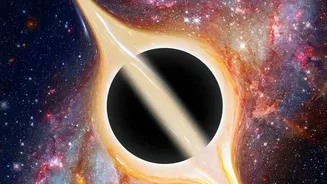
The task for a volunteer is surprisingly straightforward. Black holes themselves are invisible, as their immense gravity traps even light. However, the project focuses on black holes that are part of a binary system, orbiting a normal star. If the alignment is just right, the black hole periodically passes in front of its companion star from our perspective on Earth. When this happens, the black hole's gravity acts like a cosmic magnifying glass, bending and amplifying the star's light in an effect called 'gravitational microlensing' or 'self-lensing'. This makes the star appear temporarily brighter. Volunteers are shown 'light curves'—graphs that plot a star's brightness over time—and are asked to spot the characteristic peak that signals a potential lensing event. No advanced degree is needed, just a keen eye for patterns.
From a Laptop to the Stars
The data for this cosmic treasure hunt comes from NASA's Transiting Exoplanet Survey Satellite (TESS). While TESS's main goal is to find planets outside our solar system by looking for dips in starlight, its method of continuously monitoring stellar brightness is perfectly suited for detecting the brightening caused by a black hole. The project was co-led and developed by researchers including Dr. Adam McMaster, who started the work as a student and is now based at the University of Southampton. For participants, the appeal is the chance to make a genuine contribution. As Grace Clarke, a student participant, noted, she can search for black holes from her bedroom and potentially make a real impact on space science.