




NASA is on the verge of a historic encounter. The Lucy spacecraft, a robotic explorer on a 12-year journey, is closing in on a swarm of mysterious asteroids, promising to unlock secrets from the dawn of our solar system.
A Mission to the Solar System’s Past
Launched in October 2021, NASA's
Lucy mission is the first of its kind, designed to visit a population of enigmatic space rocks known as the Jupiter Trojan asteroids. The mission is named after the 'Lucy' hominid fossil because just as those remains gave insight into human evolution, these asteroids are expected to reveal the 'fossils of planet formation'. Over its 12-year grand tour, Lucy will fly by a record-breaking number of asteroids, providing humanity's first close-up look at these primordial objects. The primary goal is to understand the diversity of these ancient bodies, which are believed to be leftover building blocks from the creation of the outer planets like Jupiter, Saturn, Uranus, and Neptune more than four billion years ago.
Meet the Trojan Asteroids
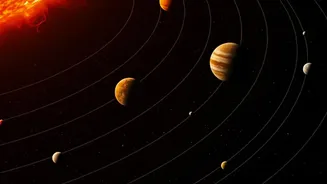
The Trojan asteroids are two large groups of space rocks that share Jupiter's orbit around the Sun. One group, known as the 'Greek camp', travels 60 degrees ahead of the gas giant, while the other, the 'Trojan camp', trails 60 degrees behind. They are trapped in these gravitationally stable locations, called Lagrange points, where the pull of the Sun and Jupiter are perfectly balanced. This has allowed them to remain relatively undisturbed for billions of years. Astronomers believe there could be as many as a million Trojan asteroids larger than one kilometre in diameter, roughly equal to the number of similarly sized objects in the main asteroid belt between Mars and Jupiter. The Lucy mission plans to visit asteroids in both of these swarms, which are separated by millions of kilometres.
What Lucy Hopes to Uncover
Scientists are fascinated by the Trojans because they show a surprising diversity in colour and composition, suggesting they may not have all formed in their current location. One leading theory is that they were captured and herded into these stable points during a chaotic period when the giant planets were migrating to their present-day orbits. By studying them up close, Lucy will help test this model. The spacecraft is equipped with a suite of advanced instruments, including a high-resolution camera, an imaging spectrometer to map surface composition, and a thermal spectrometer to measure temperature. The science objectives are to map their geology, determine what they are made of (including minerals, ices, and organic materials), and measure their mass and density.
A Twelve-Year Grand Tour
Lucy's journey is a complex orbital ballet. After its 2021 launch, the spacecraft has already performed gravity assist flybys of Earth to gain speed and adjust its trajectory. It even made some unexpected discoveries along the way, including a flyby of main belt asteroid Dinkinesh in 2023, where it found a tiny, bizarre moon that was itself a 'contact binary'—two objects stuck together. Having traveled over 2.2 billion miles, the spacecraft is now approaching the leading swarm of Trojans. The first Trojan encounter is set for August 2027 with the asteroid Eurybates and its small moon Queta. This will be followed by visits to Polymele, Leucus, and Orus through 2028. Then, Lucy will swing back toward Earth for a final gravity assist in 2030 that will send it to the trailing swarm for a 2033 flyby of the double asteroid Patroclus and Menoetius.