




Rewriting the Story of the Moon's Creation
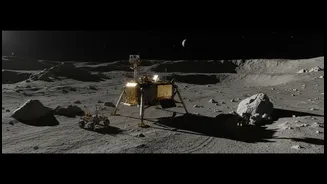
Imagine the Moon, not as a cold, dusty rock, but as a globe-spanning ocean of molten magma. This is the 'Lunar Magma Ocean' hypothesis, a long-held theory about the Moon's formation 4.5 billion years ago. New findings from ISRO's Pragyan rover have provided
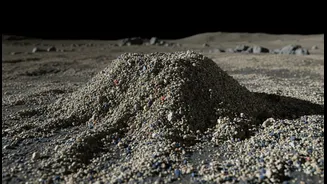
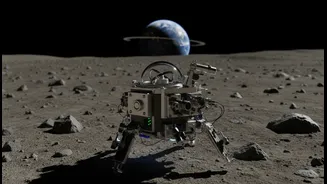
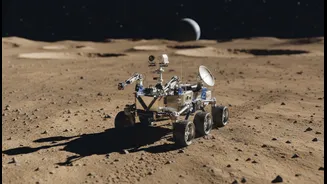
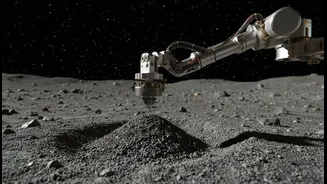
the strongest evidence yet to support this dramatic origin story. During its historic mission at the lunar south pole, the rover's Alpha Particle X-ray Spectrometer (APXS) analysed the composition of the soil at 23 different locations. The results, published in the prestigious journal Nature, were remarkably consistent: the surface is predominantly made of a rock called ferroan anorthosite. This specific type of rock is believed to have crystallised and floated to the surface as the vast magma ocean cooled and solidified. While previous missions like Apollo and Luna found similar evidence in equatorial regions, Chandrayaan-3’s data is the first to confirm it at the poles, making the magma ocean theory much more robust.
Uncovering Scars of Ancient Impacts
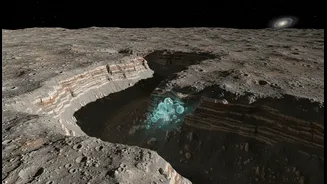
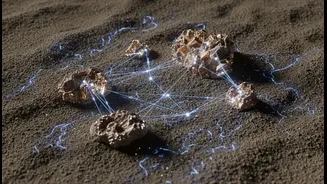
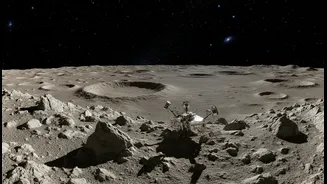
The Moon’s violent history wasn’t just fiery; it was also defined by colossal impacts. In another major discovery, scientists analysing images from Pragyan and the Chandrayaan-2 orbiter found that the Vikram lander touched down inside a massive, ancient, and previously unknown buried crater. This gigantic structure is approximately 160 kilometres wide and is believed to be even older than the South Pole-Aitken Basin, the largest known impact basin in our solar system. Over billions of years, this crater has been worn down and buried by layers of ejecta—material thrown out from countless other impacts. The soil Pragyan analysed is a complex cocktail of this debris, with some materials originating from depths of nearly 100 kilometres, likely blasted to the surface by these ancient cataclysms. These findings give scientists a unique window into the Moon's deep crust and the relentless bombardment that shaped its early existence.
A Direct Link to Earth
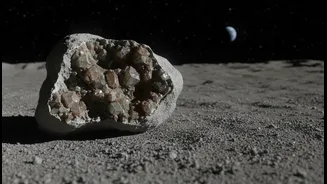
In a remarkable scientific connection spanning from Antarctica to the Moon, analysis from Pragyan has forged a link between its landing site and a specific rock here on Earth. A recent study revealed that the chemical composition of the lunar soil at the 'Shiv Shakti' landing point closely matches that of ALHA 81005, a meteorite found in Antarctica in 1981. This meteorite was the very first rock on Earth confirmed to have come from the Moon. The soil studied by Pragyan, like the meteorite, contains lower levels of aluminum and higher amounts of iron and magnesium than typical lunar highlands. This suggests the soil is a mixture of materials from different crustal layers, likely dredged up by ancient impacts. This discovery is significant because it directly connects a sample we have on Earth to its specific point of origin on the Moon, helping us better understand the formation of the lunar crust.
A Triumph for Indian Science
These discoveries are more than just academic; they represent a major milestone for India's space program and its growing prowess in science and technology. The Chandrayaan-3 mission made India the fourth country to land on the Moon and the very first to reach the unexplored south polar region. The data being analysed by an all-Indian team of scientists at institutions like the Physical Research Laboratory (PRL) is now contributing fundamental knowledge to global lunar science. By confirming the magma ocean hypothesis at the poles and discovering materials ejected from deep within the Moon's mantle, ISRO has not just successfully landed on the Moon, but has fundamentally advanced our understanding of it. Each new finding cements India's position as a leading power in space exploration, capable of conducting complex missions that yield world-class scientific results.