


The Engine of Plate Tectonics
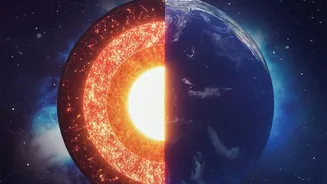
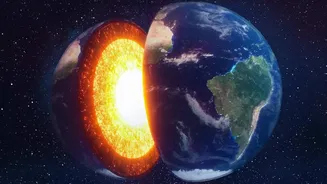
The Earth's rigid outer layer, the lithosphere, is not a single, solid shell. Instead, it is broken into more than a dozen massive tectonic plates that float on the hotter, more fluid mantle beneath them. Convection currents in this molten rock, driven
by heat from the Earth's core, act like giant conveyor belts, pushing and pulling the plates around the globe at a rate of a few centimetres per year. This fundamental process, known as plate tectonics, is the engine that drives nearly all of the planet's major geological activity, from earthquakes and volcanoes to the very shape of the continents and oceans.
How an Ocean is Born
An ocean basin begins its life on a continent. Heat rising from the mantle can cause a continent to swell and crack, creating a rift valley. As the two pieces of continental crust pull apart, molten rock, or magma, rises from the mantle to fill the gap. This magma cools and solidifies, forming fresh, dense oceanic crust. This process is called seafloor spreading. A modern example of this is the Red Sea, which is a juvenile ocean forming as the Arabian and African plates diverge. Over millions of years, this rift can widen into a vast ocean, like the Atlantic, which began forming around 180 million years ago when the supercontinent Pangea started to break apart.
The Inevitable Closure
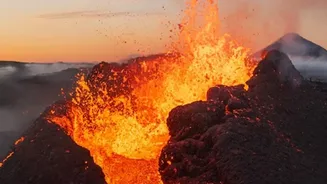
Just as new crust is created at mid-ocean ridges, old crust must be destroyed elsewhere to keep the Earth's size constant. As oceanic crust moves away from the ridge where it was born, it cools, contracts, and becomes denser. Eventually, after travelling for millions of years, this old, heavy crust may collide with a lighter continental plate or a younger oceanic plate. When this happens, the denser plate is forced to bend and sink back into the mantle in a process called subduction. These subduction zones are marked by deep ocean trenches and are hotspots for intense volcanic and seismic activity, such as the famous 'Ring of Fire' that encircles the Pacific Ocean. The Pacific is currently shrinking as the Atlantic continues to expand.
The Wilson Cycle: A Planetary Pulse
This entire sequence—from continental rifting to the creation of a new ocean basin, its subsequent shrinking via subduction, and the eventual collision of continents to close the basin—is known as the Wilson Cycle. Named after Canadian geologist J. Tuzo Wilson, who first proposed the core idea in the 1960s, this cycle describes the lifespan of an ocean basin over hundreds of millions of years. It suggests that oceans have repeatedly opened and closed along the same general lines throughout Earth's history. For example, geological evidence shows that a 'proto-Atlantic' ocean, known as the Iapetus Ocean, existed and closed before the modern Atlantic began to open.
Why This Grand Cycle Matters
This constant recycling of the oceanic crust has profound implications for our planet. The process of subduction doesn't just destroy crust; it recycles materials back into the mantle, which can then re-emerge in volcanic eruptions. This recycling of elements, including carbon, between the crust and the mantle plays a crucial role in regulating Earth's long-term climate. The collision of continents that marks the end of a Wilson Cycle creates immense mountain ranges, like the Himalayas, which formed when the Indian plate collided with the Eurasian plate. Understanding this cycle helps scientists frame the creation of sedimentary basins, which are important for petroleum exploration, and grasp the forces that generate devastating earthquakes and tsunamis.