


Our Twisted Sister Planet
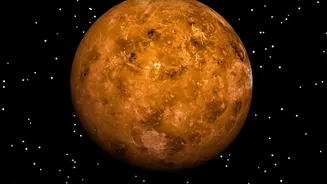
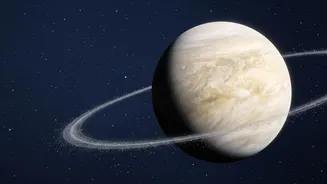
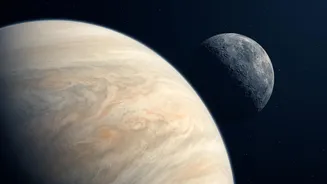
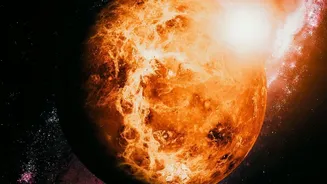
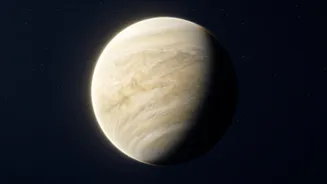
Venus and Earth are similar in size, mass, and structure, which has earned them the 'planetary twins' label. Yet, they could not be more different. Venus is a hellscape with a crushing carbon dioxide atmosphere and surface temperatures hot enough to melt
lead. It also has a bizarre rotation: a single day on Venus lasts longer than its year, and it spins backwards compared to most other planets in the solar system. For decades, scientists have also been puzzled by another key difference: why does Earth have a large, stable moon while Venus has none? Until now, theories often involved a massive external impact destroying a potential moon, or suggested one never formed in the first place.
A Ghost in the Gravitational Machine
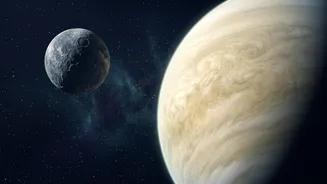
A recent study from astrophysicist Stephen Kane at the University of California, Riverside, proposes a new, more intimate culprit: Venus itself. Using computer models, Kane’s research suggests that no external catastrophe was needed to explain the missing moon. Instead, the planet’s own gravity, combined with its incredibly slow rotation, may have created a death sentence for any satellite that dared to orbit it. While Earth’s relatively fast 24-hour spin transfers rotational energy to our Moon, pushing it slowly farther away each year, Venus’s sluggish 243-day rotation would have had the opposite effect. This fundamental difference in physics sets the stage for a dramatic cosmic story.
The Doomed Moon's Death Spiral
To test this hypothesis, researchers ran a series of simulations. After validating their models by accurately recreating the Earth-Moon system, they turned their attention to Venus. They tested various scenarios, inputting different hypothetical moon masses and planetary rotation speeds. The results were shockingly consistent. In most simulations, a Venusian moon would not drift away. Instead, tidal forces from the slowly spinning planet would drag the moon inward on a decaying orbit. This process would create a gravitational tug-of-war, pulling the moon ever closer until it reached a point of no return. The simulations showed that the more massive the moon, the faster its inevitable demise would be.
Collision and Cataclysm
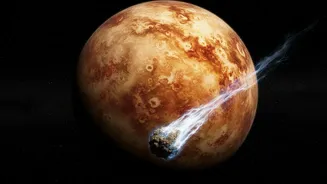
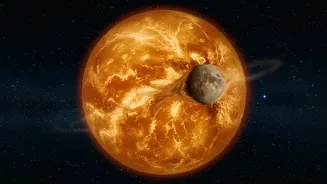
The simulations predict a cataclysmic end for this hypothetical moon. As it spiraled closer, it would eventually reach its 'Roche limit'—the distance at which the planet's gravitational pull becomes so strong that it tears the smaller body apart. The resulting debris would then rain down, crashing into Venus. Such a colossal impact would have unleashed an immense amount of energy, potentially altering the planet's geology, climate, and even its rotation in fundamental ways. Researchers suggest such an event could be connected to Venus’s current runaway greenhouse effect, a cycle where warming and heat-trapping gases reinforce each other. The loss of a moon could have had a profound impact on the planet's evolution and any potential for past habitability.
Searching for the Scars
While the simulations provide a compelling narrative, they don't prove Venus ever had a moon. Rather, they show that if a moon existed, it likely could not have survived. Finding direct evidence of this ancient collision is incredibly difficult. Much of Venus's surface appears to have been reshaped by massive volcanic activity around a billion years ago, which would have erased the scars of a much older impact. However, clues may lie hidden. Future missions could look for chemical traces of lunar debris in Venus's atmosphere. Alternatively, seismic studies could search for structures deep within the planet's mantle—remnants of the collision, similar to anomalies on Earth thought to be from the impact that created our own Moon.