





A Galaxy Forged in Fire
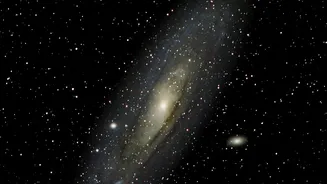
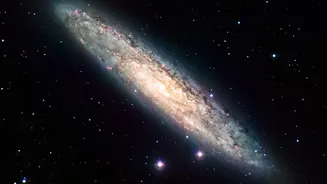
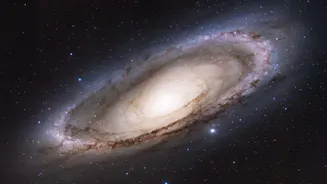
At 2.5 million light-years away, the Andromeda galaxy is a colossal structure, containing an estimated trillion stars. For decades, astronomers have studied its beautiful, sprawling disk, which is crisscrossed by what appear to be vast rings of dust and
gas. These aren't solid structures but massive, concentric regions where the raw materials for new stars are densely concentrated. These rings are not primordial features but are believed to be the echoes of a violent past. Evidence suggests Andromeda experienced a dramatic merger with another large galaxy around two billion years ago. This colossal event would have sent shockwaves rippling through Andromeda's disk, compressing gas and triggering a spectacular burst of star formation, the remnants of which we see today as these distinct rings.
The Fading Glow of Creation
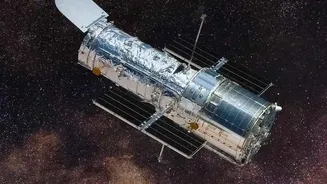
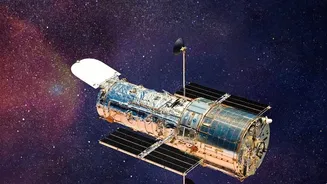
The latest chapter in Andromeda's story comes from an exhaustive new study using data from the Hubble Space Telescope. By meticulously mapping the age and location of 200 million individual stars, astronomers have created the most detailed history of star birth in Andromeda to date. The findings, published in The Astrophysical Journal, are striking: the galaxy's overall rate of star formation has been steadily declining for the past 500 million years, with the slowdown becoming even more pronounced in the last 40 million years. Five hundred million years ago, Andromeda was churning out new stars equivalent to about one of our sun's mass each year. Today, that rate has plummeted to just one-fifth of that. Much of this decline is concentrated in the very rings that were once the galaxy's most active stellar nurseries.
The Marathon Runner's Rest
So, what's causing this cosmic slowdown? Is Andromeda simply running out of gas? The research suggests the answer is no. Instead, astronomers believe the galaxy is entering a new phase of its life, a kind of cosmic middle age. The intense burst of star creation that followed its last major merger couldn't last forever. The galaxy seems to be naturally winding down from that period of high activity. One researcher likened it to a marathon runner needing to catch their breath after a long race. This means the 'momentum' being lost is not its physical rotation, but the energetic, creative force that forges new suns. Andromeda is transitioning from a vibrant, active galaxy to a more quiescent, or settled, state.
A Likely Cosmic Suspect
While the overall decline appears to be a natural part of its aging process, astronomers have also identified a potential accomplice in this story: Andromeda's small satellite galaxy, Messier 32 (M32). The Hubble data revealed a noticeable 'dead zone' in Andromeda's disk, an area surprisingly devoid of young stars. This zone is located precisely where M32's orbit would have carried it. The timing of the slowdown in this specific region, starting around 60 million years ago, strongly suggests that M32 may have punched through Andromeda's disk, disrupting the delicate clouds of gas and dust and effectively halting star formation in its wake. While astronomers can't yet say for sure, M32 remains the 'most likely suspect' for causing this localized disruption.