



So, What Are We Actually Looking At?
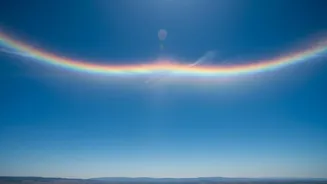
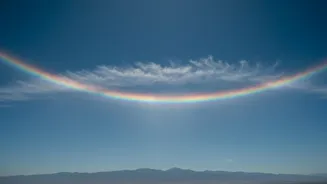
The captivating image showcases what is scientifically known as a circumhorizontal arc. It's an optical phenomenon, not a weather event like a traditional rainbow. While a regular rainbow is formed by the refraction and reflection of light in round water
droplets, a circumhorizontal arc is created by light passing through ice crystals in high-altitude clouds. The name 'fire rainbow' is informal, inspired by its vibrant, flame-like appearance and the wispy, fire-like shape of the cirrus clouds where it forms. These arcs always appear parallel to the horizon, often looking like a colourful smear painted across the sky. They are distinct from other atmospheric optical events like sundogs or halos, which have their own unique formation processes.
The Sky's Secret Recipe
Seeing a circumhorizontal arc is rare because the conditions for its formation are incredibly precise. It requires a 'perfect storm' of three key ingredients. First, the sun must be very high in the sky—at an elevation of 58 degrees or more above the horizon. This is why they are primarily a mid-latitude, summer phenomenon and cannot be seen at all in locations north of 55°N or south of 55°S, as the sun never gets high enough. Second, you need the right kind of clouds: high-level cirrus or cirrostratus clouds, which exist at altitudes so cold (above 20,000 feet) that they are composed of ice crystals instead of water droplets. Without these specific clouds, the effect is impossible.
It's All About the Ice Crystals
The third and most crucial ingredient—the one highlighted by NASA's image—is the shape and orientation of the ice crystals themselves. For a circumhorizontal arc to form, the cirrus clouds must contain plate-shaped, hexagonal ice crystals. Crucially, as these tiny crystals float downwards, they must align themselves horizontally, parallel to the ground, much like leaves falling from a tree. When the sun is high overhead, light enters the vertical side-face of these hexagonal plates and exits through the horizontal bottom face. This 90-degree path change acts like a prism, bending the light and splitting it into its constituent colours, with red appearing on top and violet on the bottom. If the crystals are randomly oriented, or are a different shape (like columns), you might see a different optical effect, like a 22-degree halo, but not a vibrant fire rainbow.
The Story Behind NASA's August 2nd Image
NASA's Astronomy Picture of the Day (APOD) for August 2, 2026, featured a spectacular example of a circumhorizontal arc photographed over North Fork Mountain in West Virginia. While the image itself was captured in 2021 by photographer Christa Harbig, its selection for APOD serves as a perfect educational moment. The explanation provided by NASA astronomers highlights how the numerous, flat, hexagonal ice crystals in the cirrus fibratus cloud must have been aligned horizontally to refract the sunlight in such a collectively similar manner. The image is a textbook case, beautifully demonstrating how these floating micro-prisms work in unison to create a large-scale optical illusion that can stretch for hundreds of miles.
Don't Confuse It With Cloud Iridescence
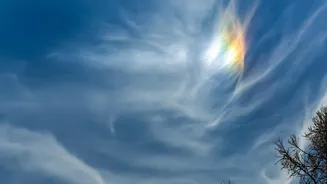
It's easy to mistake a circumhorizontal arc for another colourful sky phenomenon called cloud iridescence. Both can make clouds appear rainbow-coloured. However, there are key differences. Iridescence is caused by diffraction—light bending around water droplets or ice crystals—rather than refraction through them. The colours in an iridescent cloud often appear more random and pastel, like the sheen of oil on water, whereas a circumhorizontal arc displays a clean, well-ordered spectrum from red to violet. Furthermore, a circumhorizontal arc always appears at a specific location: below the sun. Iridescence, on the other hand, can occur in various parts of the sky, often much closer to the sun.