






A Gateway in the Clouds
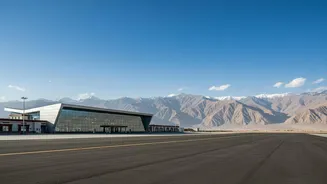
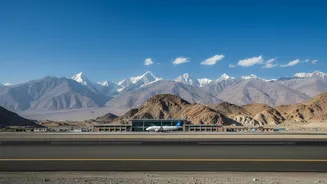
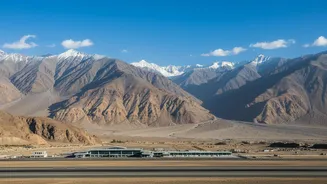
Kushok Bakula Rimpochee Airport (IXL) holds the unique distinction of being India's highest commercial airport. Situated at 10,682 feet, it is nestled in a valley surrounded by the towering peaks of the Himalayas, offering one of the most scenic and dramatic
landing approaches on the planet. For many, the flight into Leh is their first real introduction to the stark, majestic beauty of Ladakh. However, this beauty comes with a host of operational complexities. The airport operates as a dual-use facility, serving both civilian passengers and acting as a strategic airbase for the Indian Air Force, making it a critical piece of national infrastructure.
The Science of High-Altitude Flight
Operating an airport at such an altitude is a masterclass in aviation science. The primary challenge is the thin air. Lower air density reduces engine thrust and the lift generated by an aircraft's wings, meaning planes need to achieve higher speeds on a longer runway to take off. Furthermore, the weather in the mountains is notoriously fickle. Strong winds tend to pick up in the afternoon, which is why all commercial flights are scheduled for the morning hours to ensure safer operating conditions. Pilots flying into Leh must have specialised training to navigate the unidirectional approach through the mountain-flanked corridor, a task that requires immense skill and precision.
An Homage to a Modern Architect
The airport is named in honour of the 19th Kushok Bakula Rinpoche, a revered Buddhist lama, statesman, and diplomat often called the 'Architect of Modern Ladakh'. Born into a royal family, he was a pivotal figure in the region's social and political development. He served as a Member of Parliament and as India's ambassador to Mongolia, where he played a key role in reviving Buddhism after the fall of the Soviet Union. Naming the airport, Ladakh’s primary link to the outside world, after him in 2005 was a tribute to his profound influence on the region's identity and progress.
A Strategic and Economic Lifeline
The airport is far more than just a tourist gateway; it is the strategic backbone for the Indian military in this sensitive border region. It facilitates the movement of troops, equipment, and supplies to forward posts, especially during the harsh winter months when road access is completely cut off by snow. For the civilian population, the airport is an economic engine, driving the tourism sector that is crucial for local livelihoods. This dual role makes the airport's smooth functioning a matter of both national security and regional prosperity. Recent security concerns have led to tighter regulations around photography and videography at the facility to protect sensitive operational details.
The Future at Altitude
To meet growing demand from both tourism and strategic operations, Kushok Bakula Rimpochee Airport is undergoing a significant expansion. A new, state-of-the-art terminal building is nearing completion and is expected to become functional by late 2026. This new terminal, designed to reflect Buddhist philosophy, will dramatically increase passenger handling capacity from roughly 9 lakh to over 20 lakh annually. A key feature of the new building is its sustainable design, incorporating a large-scale geothermal heating system to function efficiently in Ladakh's extreme climate. Furthermore, a new parallel runway has recently been constructed, enhancing the airfield's operational capacity and resilience for both civilian and military flights.