

Ships Passing in the Night
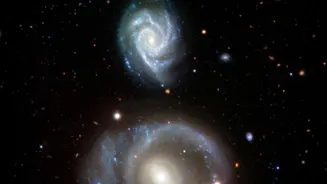
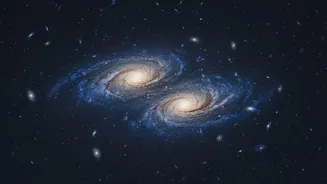
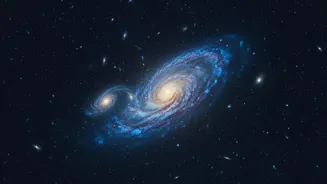
Take the stunning image of two spiral galaxies, SDSS J115331 and LEDA 2073461. At first glance, they appear to be caught in a gravitational dance, their glowing arms overlapping in a potential prelude to a merger. They look like they are about to collide,
a common and destructive event in the cosmos. Yet, this dramatic scene, located more than a billion light-years from Earth, is nothing more than a trick of the eye. The European Space Agency poetically described the pair as cosmic 'ships passing in the night'. The two galaxies are not interacting at all; they are separated by an enormous, unseen distance. Their apparent closeness is a 'chance alignment'—a perfect line-of-sight coincidence from our specific vantage point on Earth.
The Science of Seeing Through
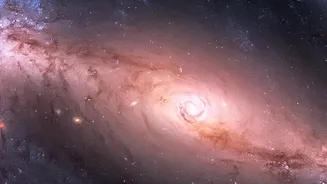
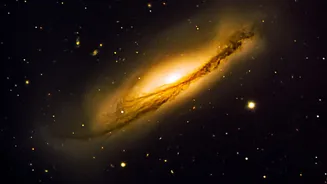
This phenomenon isn't a one-off curiosity; it’s a recurring theme in astronomy that teaches us about the universe’s three-dimensional nature. Another famous example is the galaxy pair NGC 3314. Here, a face-on spiral galaxy is perfectly silhouetted against a larger background galaxy. It creates a spectacular visual, allowing astronomers to see the dark, swirling dust lanes of the foreground galaxy in stark contrast to the bright light of the one behind it. Again, despite appearances, the two are separated by tens of millions of light-years and are moving independently of each other. These alignments are a gift to science. They provide a unique cosmic backlight, enabling researchers to map the distribution of dust and gas in the foreground galaxy in a way that would otherwise be impossible.
How to Spot a Real Collision
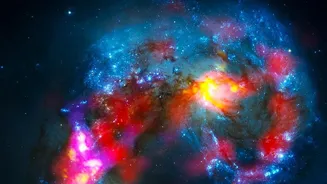
So, if some collisions are illusions, what does a real one look like? When galaxies truly interact, they leave unmistakable signs of their gravitational battle. Their elegant spiral arms get warped and stretched, pulling out long streamers of stars and gas. A powerful example is the interacting pair Arp 147, which from our perspective, amusingly resembles the number 10. The '0' is a ring of brilliant blue, the result of a smaller galaxy having punched directly through a larger one. The impact created a ripple effect, like a stone tossed in a pond, triggering a massive wave of new star formation in a brilliant blue circle. These real mergers are violent, transformative events that unfold over hundreds of millions of years and ultimately result in the creation of a single, larger galaxy.
A Universe of Deeper Meaning
The distinction between a chance alignment and a true merger is crucial. Astronomers determine the reality by carefully measuring the galaxies' motion and looking for the tell-tale signs of gravitational distortion. Misleading perspectives, far from being a problem, are a valuable tool. They remind us that the cosmos is not a flat tapestry but a vast, deep space where everything depends on your point of view. They also provide unique observational opportunities, such as studying gravitational microlensing, where the gravity of a foreground object bends the light from a more distant one. Each image of an overlapping, colliding, or interacting galaxy pair adds another piece to the puzzle of how galaxies form, evolve, and grow throughout cosmic history.