




The Classic Black Hole Image
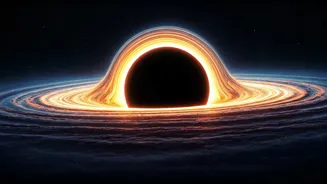
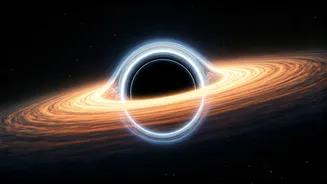
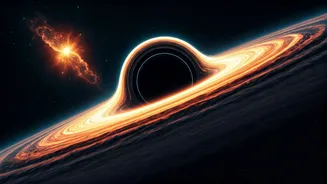
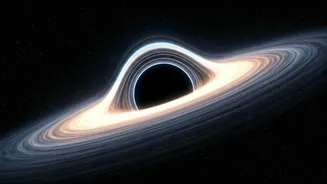
For decades, our understanding of black holes has been dominated by one defining feature: their immense gravitational pull. These are objects so dense that once something crosses their 'event horizon,' not even light can escape. We've seen this in action
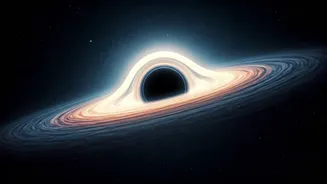
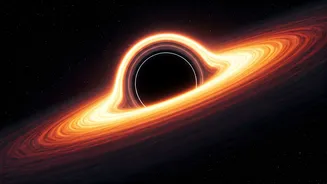
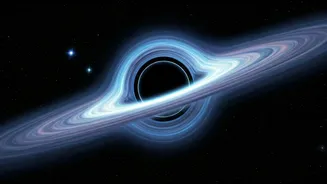
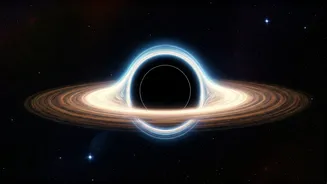
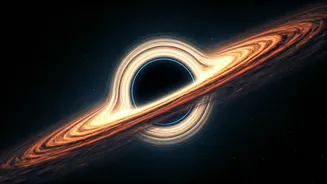
with active black holes, which are surrounded by swirling, superheated disks of gas and dust called accretion disks. As matter falls in, it creates some of the most luminous objects in the cosmos, known as quasars. In this model, the black hole is a destination of no return, a one-way street in the cosmic neighbourhood. This powerful, but simple, image has shaped our view of their role in the universe as primarily consumers of matter.
A Surprising Discovery in a Quiet Galaxy
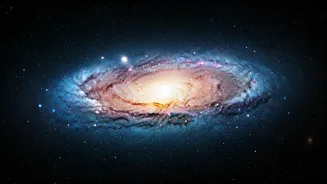
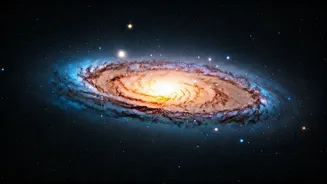
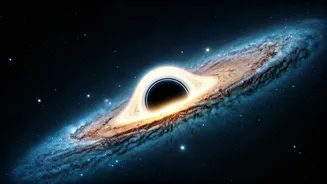
The story gets more complicated with recent discoveries about so-called 'quiescent' or dormant black holes. A study published in June 2026 has provided some of the most compelling evidence that even a sleeping giant can reshape its home. Astronomers studying the galaxy MRG-M0138, located over 10 billion light-years away, found a dormant supermassive black hole with the mass of 6 billion suns. While this black hole isn't actively feeding, analysis suggests it was once a brilliant quasar. The energy it released in its youth was so intense that it likely blew away or heated up the free-floating gas needed to form new stars, effectively shutting down star formation in the galaxy. This process is known as 'feedback', and finding its after-effects in a dormant system is a major breakthrough.
The Ghost of Activity Past
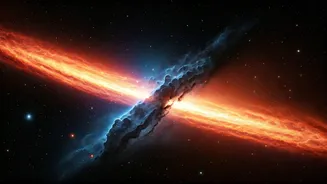
So, how does a quiet black hole push matter away? The answer lies in its history. The immense energy released during a black hole's active, feeding phase doesn't just disappear. It creates powerful outflows, often in the form of jets or winds of particles moving at near light-speed. These outflows can travel for thousands of light-years, clearing out vast regions of the host galaxy. Even after the black hole stops feeding and goes dormant, the consequences of this ancient eruption continue to ripple outwards. It's like the echo of a massive explosion that keeps expanding long after the initial blast. Scientists believe this feedback mechanism is crucial for regulating the growth of galaxies, essentially telling them when to stop making new stars.
Even a Whisper Can Be Powerful
The effect isn't just limited to the ancient past. More recent research, including observations of the supermassive black hole at the center of our own Milky Way, Sagittarius A, suggests that even barely-feeding black holes can produce 'black hole winds'. For 50 years, scientists have looked for evidence of this wind from our galaxy's relatively placid black hole. Recent findings show a huge cavity of missing material around Sagittarius A, which is too large to be explained by winds from nearby stars alone, pointing to a persistent, low-level outflow from the black hole itself. This implies that even a black hole on a starvation diet—consuming the equivalent of a single grain of rice every million years—can still exert a significant push on its environment.
Why This Changes Our Understanding
These findings are transforming our view of black holes from simple cosmic drains into complex engines that actively sculpt their galaxies. The discovery that both past activity and low-level current activity can push matter away means their influence is far more continuous and widespread than previously thought. Nearly every large galaxy has a supermassive black hole at its center, and understanding this push-pull dynamic, known as feedback, is key to solving the mystery of how galaxies evolve. It helps explain why some massive galaxies stop forming stars and become 'quenched', and it paints a picture of a co-dependent relationship where the galaxy feeds the black hole, and the black hole, in turn, regulates the galaxy's life cycle.