


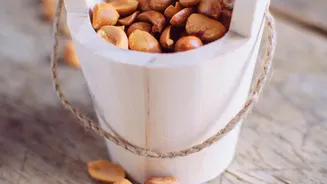
The Roasting Riddle
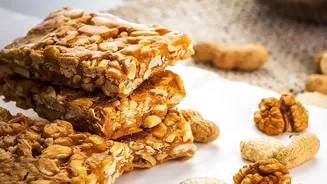
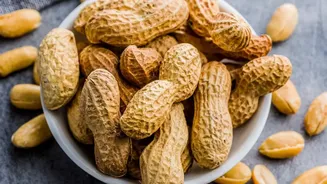
Whether you call them peanuts or moongphali, the experience of a perfectly roasted batch is a simple pleasure. Street vendors often make it look easy, expertly tossing them in hot sand until each one is flawless. Yet, when we try it at home, the results
can be disappointingly inconsistent. One nut is bitter and charred, the next still tastes raw, and a third is absolute perfection. This isn't a sign of poor roasting skills; it's a problem of physics. The culprit is almost always a lack of uniformity. When you roast peanuts of different sizes together, you're setting them up for an uneven race against the clock, a race where the smaller nuts are destined to finish long before the larger ones have even warmed up.
A Simple Lesson in Geometry
The core reason for this uneven cooking lies in a concept known as the surface-area-to-volume ratio. It sounds technical, but the idea is straightforward. Smaller objects have a larger surface area compared to their internal volume. Think of it like this: a small peanut is mostly 'surface,' while a large peanut has a lot more 'inside' that is far from the surface. Heat from your oven or pan transfers from the outside in. For a small peanut, the heat quickly reaches the centre, and the entire nut cooks rapidly. For a larger peanut, it takes significantly longer for that heat to penetrate all the way to its core. When both are on the same pan, under the same heat, the small peanuts will have cooked through and started to burn by the time the large ones are just getting started.
The Science of Sizzle and Smell
That wonderful, nutty aroma and deep golden-brown colour we associate with roasted peanuts comes from a chemical process called the Maillard reaction. This reaction, which happens between amino acids and sugars at high temperatures, is responsible for creating hundreds of complex flavour and aroma compounds. For the Maillard reaction to work its magic perfectly, the peanut needs to reach and hold a specific temperature range. If peanuts cook at different rates, their journey through this reaction becomes chaotic. The small, fast-cooking peanuts might speed past the ideal browning stage and into pyrolysis—the chemical term for burning—which creates bitter, acrid flavours. Meanwhile, the large, slow-cooking peanuts may never get hot enough internally to fully initiate the Maillard reaction, leaving them tasting bland and starchy. The result is a bag of nuts where only a fraction have hit that delicious sweet spot.
From Kitchen Science to Perfect Peanuts
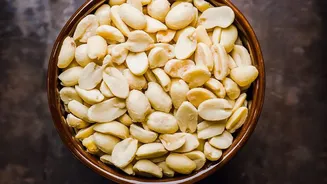
Armed with this knowledge, achieving a perfectly uniform roast becomes surprisingly simple. The solution is to ensure you're roasting peanuts of a similar size together. Before you start, take a minute to sort your raw peanuts into two or three groups based on size: small, medium, and large. You don’t need to be perfectly precise; a quick visual separation is enough. Roast each batch separately, keeping in mind that the smaller peanuts will require significantly less time in the oven than the larger ones. Start checking the small peanuts for doneness after about 10-12 minutes, while the largest ones might need 20 minutes or more. By giving each size group its own dedicated roasting time, you allow every single peanut to cook through evenly, achieving that ideal Maillard reaction and unlocking a rich, consistent, and deeply satisfying flavour across the entire batch.