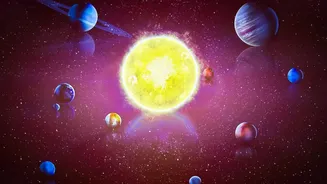




Our solar system seems like a place of reliable order, but its past was violent and chaotic. A compelling new theory suggests our cosmic neighborhood was shaped by a long-lost sibling planet—a ghost world that was sacrificed to save the rest.
The Solar System’s Missing Planet
When we look
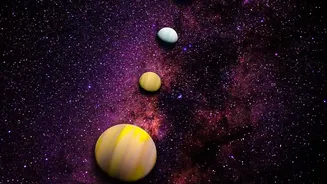
out into the galaxy, astronomers have found one type of planet again and again: the super-Earth. These are rocky worlds larger than our own but smaller than Neptune, and they appear to be incredibly common around sun-like stars. Yet, in our own solar system, there are none. This absence is a profound cosmic mystery. For decades, scientists have wondered why our planetary family is so unusual. Did a super-Earth never form here? Or, as new research suggests, did one form only to disappear in a dramatic, system-altering event billions of years ago? The answer could rewrite the story of how planets like Earth came to exist.
A Violent, Chaotic Beginning
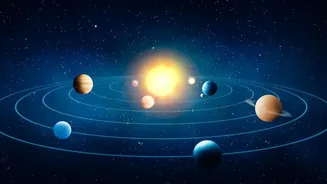
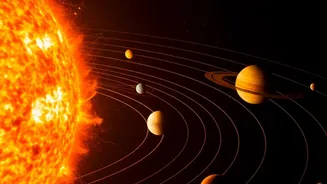
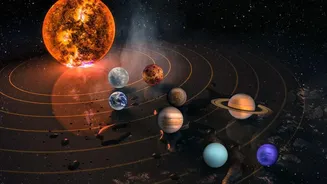
The early solar system was nothing like the orderly place we know today. It was a crowded, messy construction zone. The giant planets—Jupiter, Saturn, Uranus, and Neptune—likely formed much closer together. According to a leading theory known as the Nice model, these giants engaged in a gravitational dance that destabilized their orbits. This chaotic period, often called the giant planet instability, sent them migrating to their current positions. In the process, they flung smaller bodies called planetesimals all over the system, creating the asteroid belt and bombarding the inner worlds. But computer simulations of this era often produced outcomes that were too violent, either destroying the inner planets or failing to perfectly match the orbits we see today. Something seemed to be missing from the models.
The Ghost in the Machine
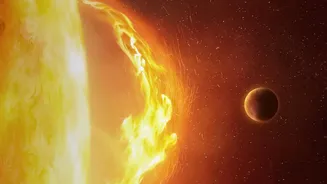
To solve this puzzle, scientists began running thousands of new supercomputer simulations. A team led by astrophysicist David Nesvorný found that adding a fifth giant planet to the early mix—an extra ice giant similar to Uranus or Neptune—made everything fall into place. In these models, this fifth planet would get caught in a gravitational tussle with Jupiter. Jupiter would then violently eject the extra planet from the solar system entirely. This cosmic sacrifice would have caused Jupiter to “jump” to a new orbit without catastrophically disrupting the inner planets, including Earth. More recent simulations have expanded on this, suggesting there could have even been one or two extra planets—potential super-Earths—that were kicked out during this tumultuous period.
An Alternative, Fiery Fate
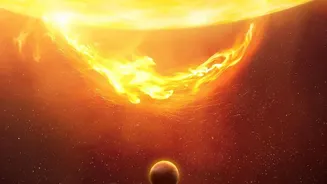
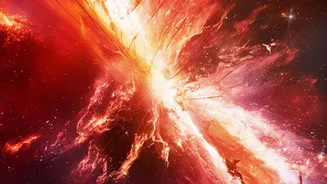
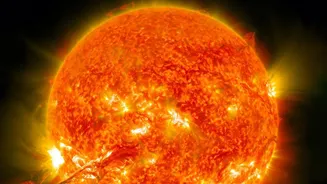
Another compelling hypothesis suggests a different end for a potential super-Earth. Instead of being thrown into interstellar space, it may have been devoured by the sun. New models from researchers including Professor Mutlu Yildiz propose that a super-Earth with five to ten times the mass of our planet could have formed in the inner solar system. Over millions of years, friction from the dense gas and dust of the early solar system would have caused its orbit to decay, sending it on a slow spiral inward. As it journeyed toward its doom, its powerful gravity would have swept the region clear of material—which could explain why the area inside Mercury’s orbit is so empty today. This planetary migration would have ended with the world being ripped apart by tidal forces and completely absorbed into the sun.
Clues Hidden in the Sun
While this sounds like the perfect crime, the sun might hold the evidence. According to the engulfment theory, swallowing a massive, rocky planet would have altered the sun's chemical composition. The planet’s heavy elements would have sunk deep into the star's interior, leaving a chemical fingerprint that could still be detectable billions of years later. Specifically, this could explain the sun’s unusually low abundance of lithium, a puzzle that has long stumped standard solar models. By feeding a hypothetical super-Earth into their solar evolution models, scientists found a much better match with the sun's observed properties. The theory remains a hypothesis, but it elegantly solves several long-standing mysteries at once.