



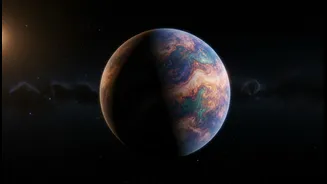

A Super-Earth in an Unlikely Place
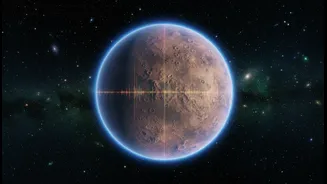
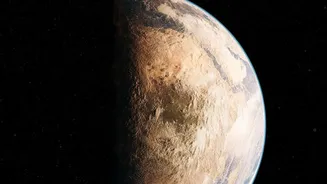
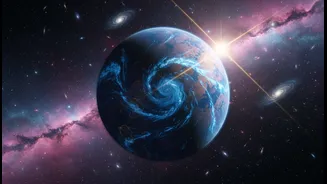
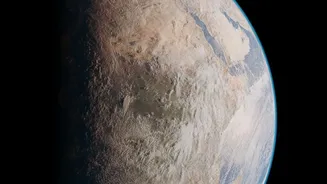
Imagine a world about 70% larger than Earth and over five times more massive. Now, place it 49 light-years away, orbiting a star much smaller and dimmer than our sun. This is LHS 1140 b, a 'super-Earth' discovered in 2017. It orbits within its star's
'habitable zone'—the not-too-hot, not-too-cold region where liquid water could potentially exist on a planet's surface. This placement alone makes it a fascinating target, but its location around a specific type of star, a red dwarf, is what makes the latest news so significant.
The Red Dwarf Conundrum
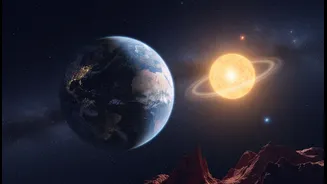
Red dwarfs are the most common type of star in our galaxy, making them prime hunting grounds for exoplanets. However, they pose a serious problem for life as we know it. Especially when young, these stars are incredibly volatile, unleashing powerful flares of radiation that can strip the atmosphere right off a nearby planet. Since a planet must orbit a dim red dwarf very closely to stay warm, it's constantly in the line of fire. For years, many astronomers wondered if any rocky planet in a red dwarf's habitable zone could hold onto its precious atmospheric blanket long enough for life to emerge.
A Breakthrough Observation
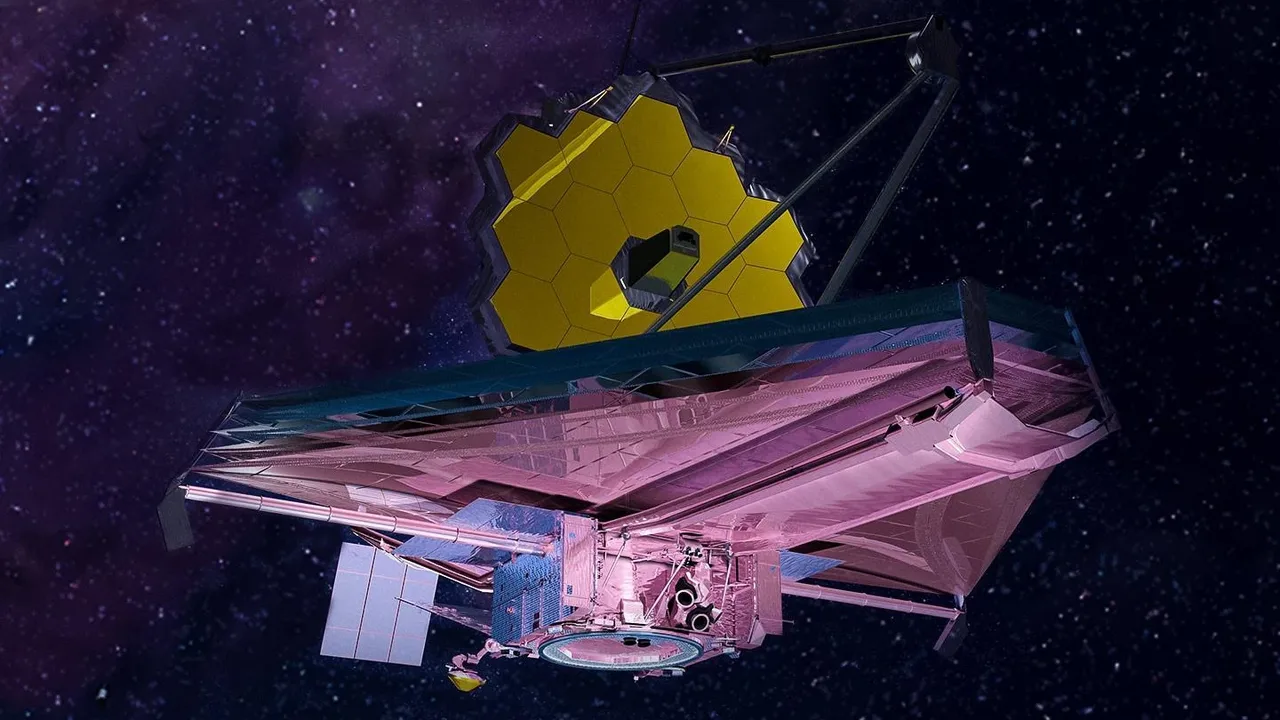
This is where LHS 1140 b changes the game. Recent studies, including some using the powerful James Webb Space Telescope (JWST), have provided our best evidence yet that this super-Earth has managed to retain a substantial atmosphere. Earlier observations had already found hints of a puffy envelope, and in July 2026, new analysis confirmed the presence of gases like helium leaking into space—a tell-tale sign of a much larger atmosphere below. This is the first time an atmosphere has been confirmed around a rocky planet in the habitable zone. JWST observations further ruled out a hydrogen-dominated atmosphere, suggesting something much denser and more interesting is going on.
An Ocean World or a Mini-Neptune?
The planet's density, which is lower than initially thought, suggests two exciting possibilities. It could be a 'mini-Neptune,' a gassy planet that is smaller than our own ice giants. More tantalizingly, it could be an 'ocean world,' a planet covered in a vast, deep ocean containing up to 10% of the planet's total mass. Further analysis of its atmospheric composition from JWST points away from a gassy, hydrogen-rich world and strengthens the case for a water world with a thick atmosphere likely composed of nitrogen, water vapor, and carbon dioxide. This makes LHS 1140 b one of the most compelling places to study in the search for habitable worlds.
The Ultimate Litmus Test
The survival of LHS 1140 b's atmosphere over billions of years is the crucial 'test' mentioned in the headline. Its star, LHS 1140, is old and relatively quiet now, but it would have been highly active in its youth. The fact that this planet weathered the storm and held onto its atmosphere provides definitive proof that it is possible. This single discovery validates the continued search for habitable worlds around the galaxy's most common stars. It tells astronomers that despite the odds, the conditions for life might exist in far more places than we previously dared to hope.