





A Planet-Sized Engine
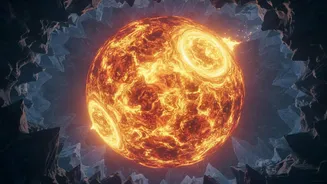
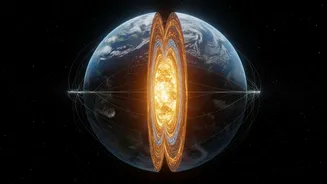
More than 2,200 kilometres below the surface, between the solid inner core and the rocky mantle, lies Earth's outer core. It’s a vast ocean of superheated, swirling liquid iron and nickel. This motion of electrically conducting metal acts like a giant
dynamo, generating the magnetic field that protects our planet from harmful solar radiation. For decades, scientists believed the flow within this core was relatively stable, dominated by a slow, large-scale westward drift. This understanding was based on careful monitoring of the planet's magnetic field, which shifts and changes in response to the core's movement. Think of it as watching the ripples on a pond to understand the currents hidden beneath.
How We See the Unseen
Directly observing the core is impossible; the deepest humans have ever drilled is a mere 12 kilometres into the crust. Instead, scientists rely on indirect methods. The most powerful tool is studying Earth's magnetic field. A constellation of satellites, like the European Space Agency's Swarm mission, constantly measures the magnetic field with incredible precision. By tracking subtle changes and fluctuations in the field over time, researchers can create models of the flow at the top of the outer core. Another method involves seismology, studying how waves from earthquakes travel through the planet. The speed and path of these waves reveal the density and state—solid or liquid—of the materials they pass through, giving us a picture of the planet's layered interior.
The Great Reversal of 2010
Analysis of satellite and ground data from 1997 to 2025 revealed something astonishing. Around 2010, a massive section of the core's flow deep beneath the equatorial Pacific Ocean did an about-face. What was once a weak westward drift abruptly reversed, becoming a strong eastward flow. This was not a small eddy but a significant regional change, challenging the long-held assumption that the core’s circulation was a slow, steady system. The discovery, published in the Journal of Studies of Earth's Deep Interior, showed that the dynamics of our planet's deep interior can change much more rapidly than previously thought, within the span of just a few years.
What Caused the Shift?
The exact reason for this dramatic reversal remains a mystery, but scientists have some compelling hypotheses. The change is what geophysicists call a "geomagnetic jerk"—a sudden acceleration of the core's flow. Some researchers theorise that the reversal is linked to events happening even deeper, possibly involving the solid inner core. There is evidence suggesting the inner core's rotation also changed its behaviour around the same time. Another possibility is that this is part of a natural, long-term cycle or oscillation that we are only now able to observe with modern technology. Recent data suggests the strong eastward flow has already started weakening since reaching a peak around 2020, lending weight to the idea that this might be a temporary fluctuation rather than a permanent new state.
Does This Affect Life on the Surface?
While a "core reversal" sounds alarming, this event poses no immediate danger to us on the surface. It is, however, fundamentally important to understanding how our planet works. The magnetic field is our first line of defence against damaging cosmic and solar radiation, and its strength and stability are directly tied to the core's behaviour. Changes in the field can affect navigation systems, satellite operations, and space weather forecasting. In 2019, the World Magnetic Model had to be updated ahead of schedule because the magnetic north pole was moving faster than expected, a change influenced by these deep-Earth dynamics. This reversal is not a sign of an impending pole flip, but a fascinating glimpse into the turbulent, powerful engine at the center of our world.