

A Portrait of a Dying Star
Despite its name, the Lion Nebula has nothing to do with planets. Officially known as NGC 2392, it is a planetary nebula, the glowing shell of gas and dust shed by a star similar to our own Sun as it reached the end of its life. For thousands of years,
the star has been expelling its outer layers into space. At its heart sits what is left of the star: an incredibly hot and dense core called a white dwarf. This stellar remnant is now illuminating the material it previously cast off, creating the celestial spectacle we see. These planetary nebulae are fleeting moments in cosmic time. Astronomers estimate that the entire Lion Nebula will fade and disperse in about 10,000 years, making images like this a precious snapshot of a star's final, dramatic act.
The Power of Webb's Infrared Eye
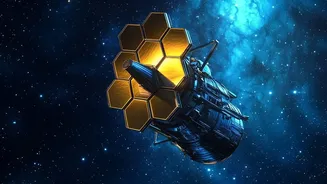
While the Hubble Space Telescope gave us remarkable views of the Lion Nebula in visible light, the James Webb Space Telescope sees the universe differently. Using its Near-Infrared Camera (NIRCam) and Mid-Infrared Instrument (MIRI), Webb detects infrared light that is invisible to the human eye. This capability is a superpower for astronomers. Infrared light can penetrate through clouds of cosmic dust that would otherwise obscure our view, allowing us to see the structures hidden within. This new composite image combines Webb's vision from different infrared wavelengths to create a comprehensive and incredibly detailed picture, revealing features that were only hinted at in previous observations.
The Secrets of Ionised Gas
The central theme of this new image is ionised gas. In simple terms, gas becomes 'ionised' when it's superheated and its atoms are stripped of their electrons. In the Lion Nebula, the culprit is the central white dwarf. This stellar core is so intensely hot that it bombards the surrounding gas with powerful radiation, essentially 'cooking' it from the inside out. This process creates a massive bubble of ionised hydrogen gas, known as an HII region, which glows brightly and forms what looks like the 'face' of the lion. The constant pressure from this radiation pushes the gas outward, sculpting it into the complex shapes Webb has now captured in exquisite detail.
What the New Portrait Uncovered
So, what’s new in this cosmic family portrait? Webb's clarity reveals the intricate structure within the expanding bubble of ionised gas. We can now see the cavernous shells and delicate tendrils with unprecedented resolution, giving scientists vital clues about how these nebulae get their complex shapes—a long-standing astronomical puzzle. Furthermore, the image provides a dramatic look at the nebula's 'mane'. This feature is composed of dust and gas, but Webb's view highlights compact clumps of dust that have managed to survive the intense radiation from the central star. These resilient clumps, appearing as red and orange features in the image, even create 'shadows' behind them, protecting other material from the star's harsh glare and forming long, comet-like tails.
Why This Cosmic Cat Matters
Studying the Lion Nebula isn't just about admiring a pretty picture. It's a unique laboratory for understanding the life cycle of the vast majority of stars in the universe. Stars like our Sun will one day go through a similar process, puffing off their outer layers and enriching the galaxy with newly forged elements like carbon and oxygen. These materials then become the building blocks for new stars, planets, and perhaps even life. By observing the dynamic interplay of radiation, ionised gas, and surviving dust in NGC 2392, astronomers can refine their models of stellar evolution. It allows them to see, in near real-time, how a star's death throes shape the cosmos and seed it for the next generation.