





The Mission's Status
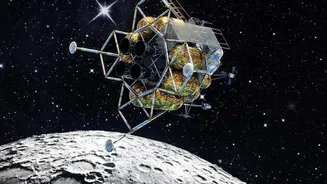
The Chang'e-6 mission successfully concluded its primary objective on June 25, 2024, when its return capsule landed on Earth, carrying approximately 1,935 grams of precious rock and soil from the lunar far side. This was the culmination of a complex,
multi-stage operation that included landing in the vast South Pole-Aitken (SPA) Basin, collecting samples, and executing a robotic ascent and rendezvous in lunar orbit. Since the return, the samples have been transferred to specialized labs where Chinese scientists are conducting initial analysis. A recent update from August 2026 noted that findings from these samples are already being integrated into new, high-resolution geologic maps of the Moon, effectively refining our understanding of its history. The mission also carried several international payloads from France, Italy, Sweden, and Pakistan, whose instruments have completed their scientific tasks, turning this into a landmark moment for international collaboration, even as US law prohibits NASA's direct involvement.
The Scientific Scale
The scientific promise of Chang'e-6 is immense because it ventured into uncharted territory. All previous lunar samples, from both the American Apollo and Soviet Luna missions, came from the near side. The Moon's two hemispheres are surprisingly different; the far side has a thicker crust, fewer volcanic plains (known as 'maria'), and is covered in more craters. The samples were collected from the South Pole-Aitken Basin, a colossal and ancient impact crater that may have excavated material from the Moon's mantle. Early studies are already yielding groundbreaking insights. Analysis suggests the water content in the far-side mantle is significantly lower than the near side, and that the mantle itself is cooler. Scientists have also found evidence of volcanic activity on the far side from billions of years ago, helping to explain why it ceased there much sooner than on the near side. Furthermore, the samples provide a unique record of the solar wind's interaction with the lunar surface, showing that particles penetrated deeper into the far-side soil because it isn't shielded by Earth's magnetosphere.
Rewriting Lunar History
With these first-of-their-kind samples, scientists can now ground-truth data that was previously only available through remote sensing. This physical evidence is crucial for testing and refining our core theories about the Moon's formation and evolution. One of the biggest mysteries is the Moon's asymmetry, and Chang'e-6's samples provide the first direct chemical and geological clues to solve it. The material from the SPA Basin could confirm whether the gigantic impact that created it billions of years ago was responsible for reshaping the entire lunar interior. Initial findings from the samples have already been used to update the official geologic timescale of the Moon, providing a new anchor point for lunar science. By comparing these far-side rocks to the younger near-side samples from missions like Chang'e-5, researchers can build a more complete and dynamic picture of the Moon's entire history, from its violent formation to its long, quiet evolution.
The Wider Geopolitical Context
The success of Chang'e-6 is more than just a scientific victory; it is a major statement in a new era of space competition. For China, it demonstrates a sophisticated and independent capability to execute highly complex deep-space missions. This achievement solidifies its position as a top-tier space power, rivaling the United States. The mission is a key part of China's ambitious long-term lunar program, which includes plans for a crewed landing by 2030 and the construction of an International Lunar Research Station at the Moon's south pole in collaboration with Russia and other partners. This stands in contrast to the US-led Artemis Accords, creating a parallel track for lunar exploration and resource utilization. For nations like India, which have their own advanced space programs, Chang'e-6 underscores the rapid pace of development in Asia and raises the stakes for future lunar and planetary exploration. The mission's success puts pressure on other space-faring nations to accelerate their own timelines and capabilities.