

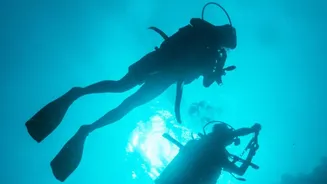


Why Signals Trump Technology
Once you descend, your hands become your primary tool for communication. While advanced voice communication systems exist, they are not standard for recreational diving and can be complex. Hand signals, taught in every basic open water course, are a universally
understood, reliable, and immediate way to convey messages. Misunderstanding or ignoring a signal can turn a minor inconvenience, like an ear-clearing issue, into a serious situation. Consistent practice and pre-dive reviews with your buddy are essential to ensure you are both on the same page. This non-verbal dialogue is the bedrock of a safe and successful dive.
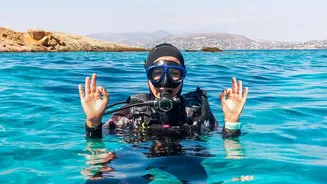
The Most Common Signal: OK
The 'OK' signal is the most frequently used gesture in diving. It is a demand-and-response signal, meaning if someone asks, you must reply. To make it, you touch your thumb and index finger to form a circle, with the other three fingers pointing up. This gesture serves as both a question ('Are you OK?') and an answer ('Yes, I am OK'). You'll use this signal to check on your buddy, and they'll use it to check on you throughout the dive. It is crucial not to confuse this with a 'thumbs-up' gesture, which in the diving world means 'ascend' or 'end the dive'.
Communicating a Problem
When something isn't right, you need to signal it clearly. The 'problem' or 'not OK' signal is made by holding your hand out flat, palm down, and rocking it from side to side like a seesaw. This indicates that something is wrong. After making this signal, you should then point to the source of the issue. For example, if you are having trouble equalizing the pressure in your ears, you would make the 'problem' signal and then point to your ear. This allows your dive buddy to understand the situation and provide assistance or wait for you to resolve it before continuing.
Air Supply and Depth Changes
Managing your air supply is paramount. To ask another diver 'How much air do you have?', tap your other palm with your index and middle finger. To indicate you are 'low on air', you make a closed fist and hold it against your chest. This is a warning, not an emergency. The signal for 'out of air', however, is an emergency. It is a slicing motion across the neck with a flat hand, which tells your buddy you need to share their air immediately. To signal an ascent, you use a 'thumbs-up' motion, and to signal a descent, you use a 'thumbs-down' motion.
Direction and Control
Dive leaders and buddies use signals to manage the group's movement. A raised, flat palm, like a traffic officer, means 'stop' or 'hold still'. This can be used to pause the group to point something out or to address a potential hazard. Pointing with your index finger is used to get your buddy's attention and direct them to 'look' at something specific. A flat hand moving up and down means 'slow down'. These simple cues are essential for navigating as a team, maintaining a safe pace, and ensuring no one misses out on seeing incredible marine life.
Emergency and Assistance
In a true emergency where you need assistance, the signal is more distinct than simply indicating a problem. Some agencies teach an open-hand wave to signal distress or the need for help. A common signal for a muscle cramp, a frequent issue for divers, is to make a repeated opening and closing fist motion towards the affected area. Your buddy can then assist by helping you stretch the muscle. For a situation where you need to share air, the signal is pointing to your mouth and then motioning towards your buddy's alternate air source regulator. Knowing these emergency signals can make a critical difference in getting help quickly and calmly.