



The Mysterious Galactic 'Wind'
When you think of wind, you probably imagine a breeze on a summer day. But in the vastness of the Milky Way, 'wind' takes on a much grander and more violent scale. This isn't air, but a colossal outflow of superheated gas, cosmic rays, and particles expanding
from our galaxy's core at incredible speeds. The most dramatic evidence of this phenomenon are two gigantic structures known as the 'Fermi Bubbles'. Discovered in 2010, these orbs of high-energy gamma rays sit above and below our galaxy's flat disk, forming a shape like a giant hourglass. Together, they span about 50,000 light-years, roughly half the entire diameter of the Milky Way. Later observations revealed an even larger, though less energetic, set of structures called the 'eROSITA bubbles' engulfing them. The sheer scale and energy required to inflate these bubbles have posed a major puzzle for astronomers: what could possibly have powered such an immense eruption?
The Cosmic Line-up of Suspects
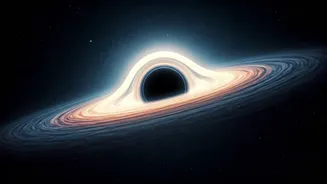
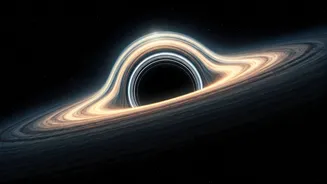
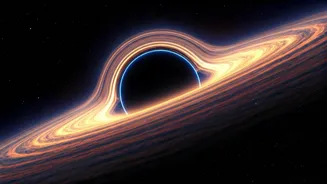
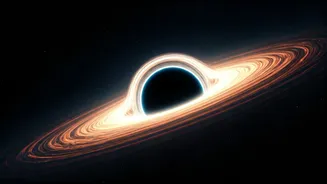
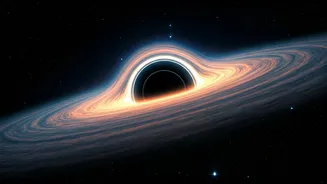
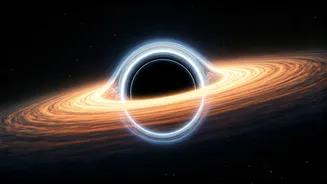
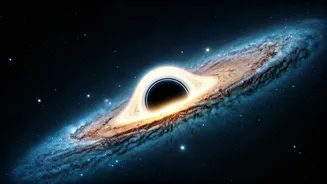
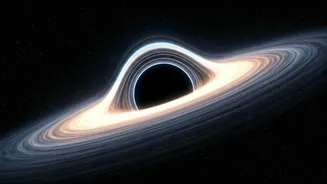
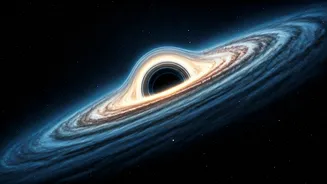
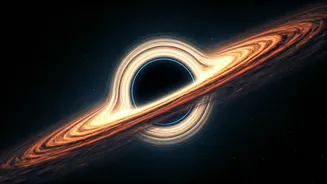
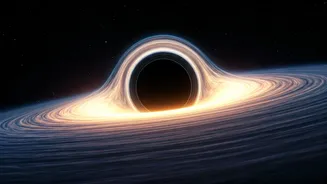
For years, scientists had two main suspects for the source of this galactic wind. The first was a period of intense star formation, known as a 'starburst'. The idea was that a rapid succession of thousands of massive stars forming and then exploding as supernovae near the galactic centre could have collectively produced enough energy to push out the gas and create these bubbles. The other, more tantalising suspect was the supermassive black hole lurking at the very heart of the Milky Way. This cosmic behemoth, known as Sagittarius A (Sgr A), has a mass about four million times that of our sun. While today it is relatively quiet, scientists theorised that a past feeding frenzy could have unleashed a torrent of energy, creating powerful jets or winds. The perfect symmetry of the bubbles above and below the galactic plane was a strong clue pointing towards an event originating from a single point source like Sgr A*.
Enter the Supermassive Suspect
Increasingly, the evidence has been stacking up against Sagittarius A. While black holes are famous for pulling things in, they are also notoriously messy eaters. As vast amounts of gas and dust spiral into a black hole, the material heats up to extreme temperatures and can be blasted outwards in powerful jets and winds. Several studies and simulations now strongly suggest that the Fermi and eROSITA bubbles are the lingering remnants of such an event. By comparing the bubbles' properties with computer models, researchers have pieced together a compelling timeline. They believe that about 2.6 million years ago, Sgr A went through a brief but violent active phase, lasting for perhaps 100,000 years. During this time, it devoured a huge amount of material and, in the process, fired off powerful jets that inflated the bubbles we see today.
The Smoking Gun
While the bubbles pointed to a violent past, a 50-year mystery remained: was Sgr A still producing any wind today? Our black hole is currently so quiet—its diet compared to a human eating one grain of rice every million years—that detecting a faint, ongoing wind has been incredibly difficult. But very recent findings have provided what many are calling the smoking gun. Using the Atacama Large Millimeter/submillimeter Array (ALMA) in Chile, astronomers created the sharpest-ever map of the cold gas surrounding Sgr A. The images revealed a distinct, cone-shaped hole in the gas, pointing directly back to the black hole. This void is exactly what scientists expected to see if a gentle but persistent wind was blowing from the black hole, clearing out the cold gas in its path. After decades of searching, the elusive modern-day wind had finally been found.