

The Ocean's Carbon Sponge
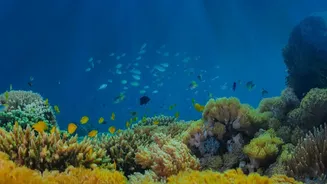
The concept behind ocean iron fertilization, or OIF, is modelled on a natural process. Microscopic marine plants called phytoplankton act as the ocean's lungs, producing oxygen and absorbing vast amounts of carbon dioxide through photosynthesis. In many
parts of the vast open ocean, particularly the Southern Ocean, phytoplankton growth is limited not by sunlight or major nutrients, but by a scarcity of the micronutrient iron. The theory, first proposed in the 1990s, is that adding small amounts of iron to these regions could trigger enormous phytoplankton blooms. As these organisms die, they would theoretically sink into the deep ocean, taking the carbon they absorbed with them and locking it away from the atmosphere for centuries. It's an appealing form of geoengineering, essentially giving the ocean's natural carbon cycle a powerful boost.
A Question of Permanence
While experiments have confirmed that adding iron does indeed create impressive plankton blooms, a key question has always been about permanence. How much of that captured carbon actually makes it to the deep sea and stays there? Recent analyses and models paint a disappointing picture. Much of the carbon is simply recycled in the upper layers of the ocean and released back to the atmosphere relatively quickly. Some modelling suggests that for most of the ocean, half of the sequestered carbon would be retained for less than 150 years. According to some estimates, only around 2% of the carbon from the bloom might reach the deep-sea floor, with a tiny fraction of that, perhaps 0.2%, being permanently preserved in the sediment. This dramatically lowers the efficiency and long-term climate benefit of the strategy.
The Downstream Dilemma
Perhaps the most significant limitation revealed by new research is the interconnectedness of the ocean. A 2023 study using advanced ocean models highlighted a critical 'robbing Peter to pay Paul' scenario. The research showed that large-scale fertilization in the Southern Ocean would consume nutrients that would otherwise have drifted downstream to other regions. This nutrient theft could starve ecosystems thousands of miles away, particularly in the tropics. The models projected that this effect could worsen the decline in animal biomass and fisheries already being caused by climate change, hitting coastal communities that depend on them. Further research found this compensation effect can be massive, with one study suggesting that 80-85% of the carbon uptake from fertilization in the Pacific was cancelled out by reduced carbon uptake elsewhere. This finding suggests that OIF may not add much new carbon removal to the global system, but rather just shift where it happens, with potentially damaging consequences.
A Cascade of Unintended Risks
Beyond its questionable efficiency, OIF comes with a host of serious ecological risks. The decay of the massive plankton blooms consumes vast amounts of oxygen. This could lead to the expansion of low-oxygen or anoxic 'dead zones' in the water column and on the seafloor, harming marine life. Furthermore, artificially engineering a bloom risks fundamentally altering the marine food web. It could favour certain species of phytoplankton over others, potentially leading to harmful algal blooms, the toxic phenomena also known as red tides. Scientists also worry about the release of other powerful greenhouse gases, like nitrous oxide and methane, during the process, which could partially offset any climate benefits from CO2 removal. These unpredictable side effects are a major reason for caution.
Not a Silver Bullet Solution
When all the factors are considered, the potential climate impact of ocean iron fertilization appears limited. Even highly optimistic models, which assume an efficiency that may be difficult to achieve in the real world, suggest that a sustained, large-scale OIF program could remove at most a few dozen gigatonnes of carbon by the end of the century. This sounds like a lot, but it is equivalent to only a few years of humanity's current annual emissions. The sheer scale required for even this modest impact—fertilizing an area potentially as large as the entire Southern Ocean for decades—makes the logistical challenges and ecological risks immense. It is far from the silver bullet some had hoped for.