






What is the Deadwood?
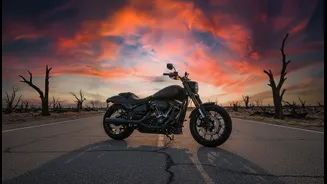
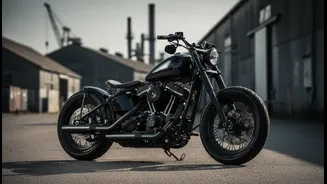
Harley-Davidson has officially unveiled the Deadwood, a new model for 2026 that channels the spirit of post-WWII garage-built bobbers. Rather than a bike you have to build, it’s a bike you can buy. The Deadwood is essentially a stripped-down, blacked-out
version of the popular Heritage Classic, but with a personality all its own. It arrives with a solo seat, chopped fenders, and a lowered stance, giving it an aggressive, minimalist profile right off the showroom floor. The design philosophy is clear: provide the aesthetic of a heavily modified custom bike with the reliability and finish of a factory model. It’s aimed at riders who crave that unique, rebellious look but prefer riding over wrenching.
Stripped-Down Style, Modern Power
The Deadwood’s defining feature is its dark, uncluttered look. Nearly every component, from the handlebars and controls to the powertrain and exhaust, is finished in black. This blacked-out treatment is contrasted by a classic Denim Black paint job and minimal chrome accents on the engine to highlight the iconic V-twin shape. The bike sits on black-rimmed laced wheels and features a solo tuck-and-roll seat that contributes to its low, slammed profile. But this isn’t just about looks. At its heart is the formidable Milwaukee-Eight 117 V-Twin engine, a 1,923cc powerhouse tuned for strong low- and mid-range torque. Harley-Davidson claims outputs of 98 horsepower and 120 lb-ft of torque, ensuring the performance matches the muscular styling.
Tech-Forward and Rider-Focused
While the Deadwood’s styling is vintage-inspired, its technology is thoroughly modern. It comes standard with Harley-Davidson's Rider Safety Enhancements, a suite of electronic aids that includes cornering-enhanced anti-lock brakes (C-ABS) and traction control (C-TCS). This system adjusts braking and acceleration based on the bike's lean angle, providing an extra layer of confidence in tricky situations. The bike also features selectable ride modes (Road, Sport, and Rain), allowing the rider to tailor the throttle response to different conditions. This blend of old-school cool and new-school tech makes the bike more accessible to a wider range of riders, proving that a raw-looking bike doesn't have to mean a raw riding experience.
A New Chapter in Custom Culture
The introduction of the Deadwood signals a strategic shift for Harley-Davidson. For years, the brand's CVO (Custom Vehicle Operations) models have offered premium, factory-customized bikes, but often at a very high price. The Deadwood, along with other recent releases like the Super Glide, represents a new approach: offering limited-run, custom-inspired models at a more attainable price point. It acknowledges a growing market of riders in India and globally who desire personalization and self-expression but may lack the time, skills, or resources for a ground-up custom build. This doesn't spell the end of traditional customization; instead, it broadens the definition of what a custom bike can be. It offers a new entry point into a culture that has always been about making a bike your own, whether that starts in a garage or at a dealership.
The Indian Context
While the 2026 Deadwood has been announced exclusively for the U.S. and Canadian markets for now, its philosophy resonates strongly with the Indian market. Factory customs like the Street Bob have proven popular in India, offering a distinctive look combined with brand assurance. The Deadwood’s concept of a pre-packaged, clean bobber style would likely find a willing audience. The high cost and logistical challenges of aftermarket customization in India make factory-finished models an attractive proposition. Should Harley-Davidson decide to bring this model or similar concepts to India, it would fit perfectly alongside bikes like the Softail Standard and Street Bob, offering another compelling choice for riders looking to join the Harley family with a bike that stands out from the crowd.