



A Mission to Our Origins
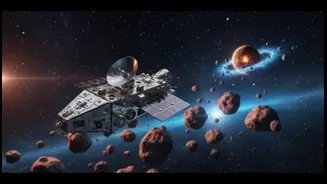
Launched in 2021, NASA’s Lucy spacecraft is on an ambitious 12-year journey to explore some of the most ancient objects in our solar system. Its primary targets are the Trojan asteroids, two mysterious swarms that lead and trail Jupiter in its orbit.
These primordial bodies are thought to be leftovers from the formation of the outer planets. By studying them up close, scientists hope to gain unprecedented insights into how our solar system came to be. But on its way to the Trojans, Lucy had a practice run with a small asteroid in the main belt called Dinkinesh, and what it found was anything but ordinary.
An Encounter with Dinkinesh
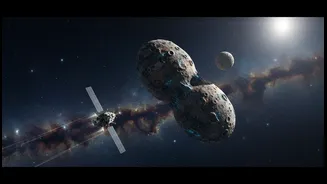
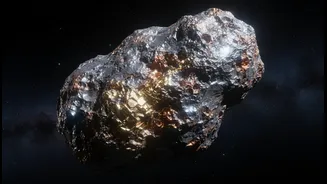
In November 2023, Lucy flew past Dinkinesh, a tiny asteroid less than a kilometer wide. The flyby was initially intended as a test of the spacecraft's tracking systems, but it delivered a major scientific surprise. Images revealed that Dinkinesh was not alone; it had a small moon, which was later named Selam. More astonishingly, further analysis showed that Selam itself is a 'contact binary,' meaning it's made of two smaller objects that gently fused together. This was the first time such an object had been seen orbiting another asteroid, immediately raising questions about how this strange system formed.
Reading the Asteroid's Scars
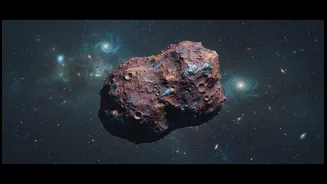
The key to unlocking the mystery lay on the surface of Dinkinesh itself. The spacecraft's detailed images revealed a prominent trough gouged out near its equator, alongside a distinct ridge. Scientists believe these are not random features but are, in fact, historical scars telling a story of a dramatic event. The leading theory is that over millions of years, the gentle push from sunlight caused Dinkinesh to spin faster and faster. This phenomenon, known as the YORP effect, is a subtle but powerful force in the lives of small asteroids.
A Moon Is Born
As Dinkinesh's rotation accelerated, centrifugal force caused material to shift and stress to build. Eventually, the asteroid reached a breaking point. A huge chunk of rock, perhaps a quarter of its total size, broke away from the main body. This cataclysmic event flung a cloud of debris into orbit. Some of this material rained back down onto Dinkinesh, forming the equatorial ridge we see today. The rest of the debris coalesced in orbit, gradually clumping together to form the strange, two-lobed moon, Selam. The trough on Dinkinesh's surface is the scar left behind by this planetary-scale shedding event.
A Snapshot of Planet Formation
This discovery is significant because it provides the first direct observational evidence of this moon-formation process. Scientists have long theorized that spinning asteroids could shed material to form satellites, but the Dinkinesh-Selam system is a perfect, real-world example. It’s like finding an archaeological site that confirms a long-held historical theory. According to Hal Levison, the principal investigator for the Lucy mission, understanding how small bodies like this break apart or stick together is crucial for understanding how planets themselves were formed. Each asteroid collision and formation event is a piece of the puzzle of our own planet's origins.