



Standard Security: The Default Protection
Most major email providers like Gmail and Outlook use a type of security called Transport Layer Security (TLS). Think of it like an armored truck carrying a letter from one post office to another. While the letter is inside the truck (in transit), it's
protected from anyone trying to snatch it on the road. However, once it arrives at the post office (the email provider's server), it's taken out of the truck and can be read by the staff there before being sent on its next leg. This process, known as encryption-in-transit, protects your email from hackers on public Wi-Fi but leaves the message accessible to your email provider. The provider can scan your emails for keywords, add calendar invites, or comply with legal data requests. For most everyday communication, this is a reasonable and effective level of protection.
End-to-End Encryption: The Digital Safe
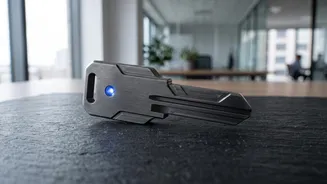
End-to-end encryption (E2EE) is a much stronger form of security. Instead of just protecting the journey, it protects the message itself. Imagine sealing your letter in a locked box before it even leaves your house. Only you and your intended recipient have the unique key to open it. No one in between—not the postal worker, not the postmaster, and certainly not an eavesdropper—can see what's inside. With E2EE, the message is encrypted on your device and only decrypted on the recipient's device. Even the email service provider cannot access the contents of your messages because they don't have the decryption keys. This is what's known as 'zero-access' encryption, and it offers a powerful guarantee of privacy.
When Standard Security Is Good Enough
The truth is, not every email needs to be locked in a digital fortress. For the vast majority of your daily communications, standard TLS encryption is perfectly adequate. This includes things like confirming a dinner reservation, sharing links with friends, subscribing to newsletters, or coordinating casual plans. The risk of a sophisticated actor targeting these low-stakes messages is minimal, and the protection offered by major providers against common threats like network snooping is sufficient. Overstating encryption everyday chatter can add unnecessary complexity. The key is to match the level of security to the sensitivity of the information being sent. For most people, most of the time, the default security settings do their job well.
When End_to_End Security Is Critical
The need for E2EE becomes urgent when the information you're sharing is highly sensitive. For professionals like journalists communicating with sources, lawyers discussing client cases, or doctors sharing patient data, E2EE is essential for confidentiality and compliance with regulations like GDPR. Business executives sharing trade secrets, financial data, or internal strategies also fall into this category. Similarly, activists, dissidents, and individuals living under repressive regimes rely on E2EE to protect their freedom of expression and personal safety from surveillance. If the content of an email could cause significant personal, financial, or professional harm if exposed , it's a clear signal that you need the robust protection that only end_to_end encryption can provide.
While E2EE offers superior security , it comes with some practical drawbacks . Because the email provider can't read the content , useful features like server_side search or automatic calendar invites from an email's text may not work . Furthermore , true E2EE generally requires both the sender and the recipient to use compatible services or software . Sending an end_to_end encrypted email from a secure provider like Proton Mail to a standard Gmail address often means the message loses its E2EE protection upon arrival or requires the recipient to use a password and a web portal to view it , which adds friction . Metadata—like the sender , recipient , and subject line—is also typically not encrypted , meaning that information remains visible .
The easiest way to use E2EE is by signing up for an email service that builds it in by default . Providers like Proton Mail and Tuta (formerly Tutanota) are designed around this principle , automatically encrypting messages sent between their users . These services are based in countries with strong privacy laws , like Switzerland and Germany . For those who want to add E2EE to existing accounts like Gmail or Outlook , it's possible but more complex . This usually involves installing thirdparty tools that use standards like PGP (Pretty Good Privacy) or S/MIME . This approach requires managing your own encryption keys and ensuring your recipients are also set up to decrypt the messages , which can be a technical hurdle for many users .