







The Fiery Return to Earth
When the Gaganyaan crew module re-enters Earth's atmosphere, it will be travelling at hypersonic speeds, creating immense heat and stress. The primary braking force is atmospheric drag, which scrubs off most of the velocity. However, to ensure a gentle
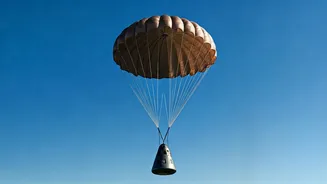
splashdown in the Indian sea waters, the module's speed must be drastically reduced from nearly 700 kilometres per hour to a manageable 30 kilometres per hour. This is where the parachute deceleration system, a marvel of engineering developed jointly by the Indian Space Research Organisation (ISRO) and the Defence Research and Development Organisation (DRDO), comes into play.
A Ten-Parachute Symphony
The safe return of the astronauts depends on a perfectly timed sequence involving a total of ten parachutes of four different types. The process begins at an altitude of about 15 to 17 kilometres. First, two Apex Cover Separation parachutes deploy, which, as the name suggests, jettison the protective cover of the parachute compartment. Immediately after, two Drogue parachutes are released. These smaller, sturdy parachutes are crucial for stabilising the fast-moving module and providing the initial, significant reduction in velocity. These conical, ribbon-type parachutes are ejected using pyro-based mortars, designed to handle the extreme forces at this stage of descent.
From Drogues to Mains
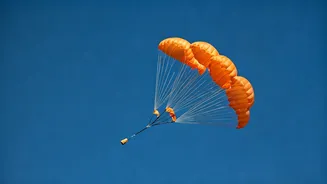
Once the Drogue parachutes have done their job and are released, the next phase begins. Three small Pilot chutes are deployed. The sole purpose of these pilot chutes is to pull out the three massive main parachutes from their compartments. Each of the three main parachutes is extracted individually to ensure a controlled and tangle-free deployment. This is the final and most crucial braking phase, designed to slow the multi-tonne crew module to a speed safe enough for a soft splashdown.
Redundancy and Rigorous Testing
In human spaceflight, there is no room for error, which is why the parachute system is built with redundancy. While there are three main parachutes, only two are required to land the crew module safely; the third acts as a critical backup. This system has been subjected to a battery of gruelling tests. ISRO and DRDO's Aerial Delivery Research and Development Establishment (ADRDE) have conducted numerous Integrated Main Parachute Airdrop Tests (IMAT). In these tests, a dummy mass equivalent to the crew module is dropped from an Indian Air Force IL-76 or Chinook helicopter from an altitude of several kilometres to simulate mission conditions. Tests have been conducted at facilities like the Babina Field Firing Range and the Rail Track Rocket Sled (RTRS) facility to validate the system's performance in extreme scenarios, including delayed parachute openings and asymmetric loads.
Controlled Inflation for a Smooth Ride
Simply deploying a massive parachute at high speed would create a violent shock that could damage the capsule or harm the crew. To prevent this, the main parachutes use a technique called 'reefed inflation'. This means the parachute first opens only partially (reefing), allowing it to catch the air more gently. After a short, predetermined delay managed by a pyro device, a mechanism cuts the reefing lines, and the parachute inflates to its full size (disreefing). This two-stage process ensures the load on the capsule is manageable and the deceleration is smooth, safeguarding both the structure and its precious human cargo.