

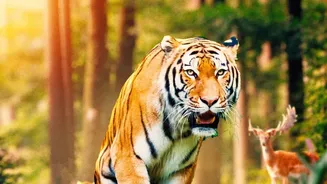
Białowieża Forest: Europe's Last Primeval Wilderness
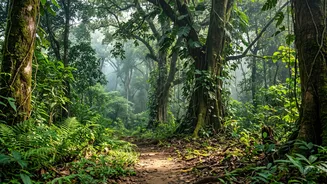
Straddling the border of Poland and Belarus, the Białowieża Forest is a living relic and a designated UNESCO World Heritage site. It is celebrated as the last significant remnant of the lowland primeval forests that once covered much of Europe. This is not
just a collection of trees; it's a complete, ancient ecosystem where nature unfolds with minimal human interference. The forest is characterized by its wealth of old-growth trees and a remarkable amount of dead wood, which creates a vital habitat for thousands of species of fungi and invertebrates. The star of Białowieża is undoubtedly the European bison, the continent's heaviest land animal. Brought back from extinction and reintroduced here, the forest now hosts the world's largest free-roaming population. Visitors can also spot wolves, lynx, otters, and over 250 species of birds. To truly experience its wild heart, join a guided tour into the strictly protected zones, where you can walk among giant, centuries-old oaks and witness an ecosystem functioning as it has for millennia.
Prague: A Fairytale City Carved in Stone
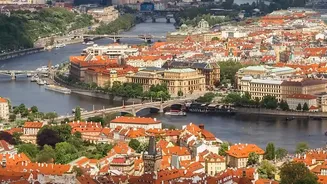
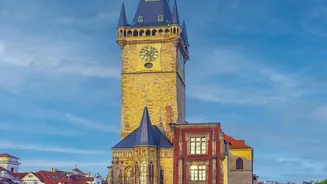
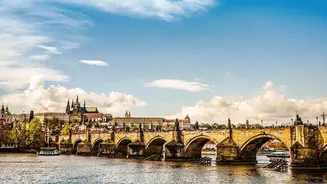
Inscribed as a UNESCO World Heritage site in 1992, the Historic Centre of Prague is one of the world's most beautiful and best-preserved urban landscapes. Its beauty lies in an uninterrupted architectural dialogue spanning over 600 years, with Gothic, Renaissance, and Baroque styles blending seamlessly along its cobblestone streets. The journey begins at Prague Castle, a sprawling complex of palaces, churches, and gardens that holds the Guinness World Record for the largest ancient castle. Within its walls stands the magnificent St. Vitus Cathedral, a Gothic masterpiece that took nearly six centuries to complete. From the castle, wander down to the Vltava River and cross the iconic Charles Bridge, a pedestrian-only artery adorned with 30 baroque statues that has connected the two sides of the city since the 14th century. The bridge leads you into the heart of the Old Town Square, where you can marvel at the famous Astronomical Clock, which puts on a show every hour. Every corner of Prague tells a story, making it a living museum of European history and art.
The Danube Delta: Europe's Wild Waterworld
Where the mighty Danube River meets the Black Sea, it forms the Danube Delta, the second-largest and best-preserved delta in Europe. Shared between Romania and Ukraine, this vast wetland of marshes, channels, lakes, and islands was declared a UNESCO World Heritage site for its incredible biodiversity. Often called 'Europe's Amazon', the delta is a paradise for nature lovers, supporting over 3,400 animal species and 1,700 plant species. It is most famous as a birdwatcher's haven, hosting more than 300 species, including the largest colonies of white and Dalmatian pelicans on the continent. The delta is a labyrinth of water that is best—and often only—explored by boat. Licensed guides can navigate you through narrow canals draped in willows and past vast reed beds to secluded lakes covered in water lilies. Beyond the wildlife, the area is dotted with small fishing villages where traditional lifestyles persist. A visit here offers a peaceful escape into one of Europe's last great wildernesses, a dynamic landscape shaped by water and time.