





A Mysterious Glow in Our Galaxy
Astronomers have pinpointed a mysterious source of high-energy gamma rays whose origin has long been an enigma. The source, catalogued as HESS J1507−622, was first detected years ago but puzzled scientists because it had no counterpart in other wavelengths
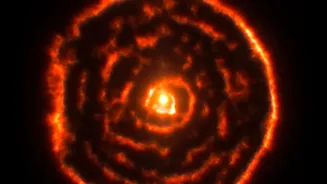
like X-rays or radio waves. New research from a team of Chinese and US scientists suggests a tantalizing possibility: this glow could be the after-effect of a kilonova—a cataclysmic explosion caused by the merger of two neutron stars. These mergers are thought to be the primary cosmic source of the universe's heaviest elements, including gold and platinum. The researchers' model suggests that the debris from such a merger could indeed produce the unique gamma-ray signature observed. If confirmed, this would be the first kilonova remnant ever identified in the Milky Way.
Anatomy of a Cosmic Forge
So, what exactly is a neutron star merger? Neutron stars are the incredibly dense collapsed cores of massive stars that have exploded as supernovae. They pack more mass than our sun into a sphere just the size of a city, and a single teaspoon of their matter would weigh billions of tonnes. Sometimes, two such stars exist in a binary system, orbiting each other. Over millions of years, they spiral inward, shedding energy as gravitational waves, until they finally collide in a violent smash-up. This event, a kilonova, is one of the most powerful explosions in the universe, releasing a torrent of energy and matter. It is within this chaotic, superheated environment that the conditions become right for creating the universe's most precious metals.
The 'r-Process': How Gold is Made
The creation of elements like gold happens through a mechanism called the rapid neutron-capture process, or 'r-process'. In the extreme conditions of a kilonova, a dense flood of neutrons bombards atomic nuclei. The nuclei absorb these neutrons at a furious rate, becoming heavy and unstable before they have a chance to decay. Subsequently, these unstable nuclei undergo radioactive decay, transforming into more stable, heavy elements like gold, platinum, and uranium. The 2017 detection of gravitational waves from a distant neutron star merger, an event named GW170817, provided the first direct evidence linking these collisions to the r-process, as telescopes observed the distinct signature of freshly forged heavy elements in the explosion's aftermath.
A Fossil of an Ancient Blast
Finding evidence of a kilonova inside our own galaxy is a major step forward for what scientists call 'galactic archaeology'. The candidate remnant, HESS J1507−622, is located away from the main plane of the Milky Way, which is consistent with the powerful 'kick' that binary neutron star systems can receive when they form. Researchers estimate the explosion may have happened less than 1,000 years ago—a blink of an eye in cosmic terms. Studying such a 'young' remnant allows astronomers to test their models of element formation and kilonova physics with unprecedented detail. It’s like finding a pristine fossil, giving us a direct look at the debris from a single, powerful event that seeded a small corner of our galaxy with the building blocks for future stars, planets, and perhaps even treasured heirlooms.