



A Relic on the Frontier
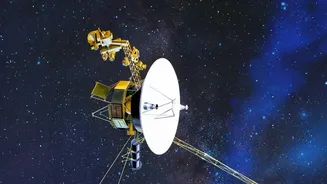
Launched in August 1977, just weeks before its twin, Voyager 1, the Voyager 2 probe is one of humanity’s greatest success stories. Designed for a five-year mission to Jupiter and Saturn, it went on to become the only spacecraft to have ever visited Uranus
and Neptune, completing a “Grand Tour” of the outer solar system. Now, at over 21 billion kilometres from Earth, it has long since crossed the heliopause—the boundary where the Sun’s influence ends and interstellar space begins. It continues to send back invaluable data from this unexplored region, a place no other active probe has reached. Yet this remarkable achievement comes with immense challenges. The spacecraft is a technological time capsule, operating on computers with less memory than a modern car key fob and communicating with a transmitter less powerful than a refrigerator light bulb.
The Inescapable Decline of Power
The single greatest threat to Voyager 2 is its dwindling power supply. The probe isn’t solar-powered; at its distance, the sun is just another bright star. Instead, it relies on three Radioisotope Thermoelectric Generators (RTGs), which convert heat from decaying plutonium into electricity. This process is incredibly reliable but has a finite lifespan. Every year, the decaying fuel causes the spacecraft to lose about 4 watts of available power. Four watts may not sound like much, but on a machine with razor-thin energy margins, it’s the difference between running a scientific instrument and shutting it down forever. To manage this decline, NASA engineers have been forced to make increasingly difficult choices, powering down non-essential systems and, since 2024, even some of its remaining science instruments.
The Communication Tightrope
Communicating with Voyager 2 is a lesson in patience and precision. A command sent from NASA’s Deep Space Network (DSN) takes over 18.5 hours to reach the spacecraft. Engineers then have to wait another 18.5 hours to receive a response, meaning a single exchange takes the better part of two days. There is no live troubleshooting. This colossal delay makes every command a calculated risk. A minor error in a software update or a command to reorient its antenna could have catastrophic consequences. This was starkly illustrated in mid-2023, when a series of commands inadvertently caused Voyager 2's antenna to point two degrees away from Earth, severing contact. For weeks, the probe was silent. Fortunately, engineers managed to “shout” a command to reorient the craft, but the incident highlighted the mission's profound fragility.
The 'Big Bang' Gamble
Faced with the prospect of shutting down another science instrument by the end of 2026, the mission team recently undertook a high-stakes operation nicknamed the “Big Bang.” The plan involved simultaneously shutting down certain power-hungry hardware and switching to lower-power alternatives while ensuring the probe remained warm enough to survive the frigid temperatures of deep space. If the fuel lines for its thrusters were to freeze, the spacecraft would lose its ability to point its antenna at Earth, effectively ending the mission. The gamble paid off, freeing up just enough power to keep its remaining three active instruments running for at least another year. This same procedure is planned for Voyager 1 in the coming months.
A Human Legacy
The survival of Voyager 2 is as much a human story as it is a technological one. It’s a testament to the ingenuity of its original designers and the dedicated team at NASA's Jet Propulsion Laboratory who keep it flying. This team of engineers acts as long-distance mechanics for a machine nearly half a century old. They write code for obsolete systems, anticipate failures in aging hardware, and make difficult decisions about which precious scientific data to sacrifice for the sake of survival. Every watt saved is a choice about what humanity gets to learn from the interstellar medium. While the probes were only designed to last five years, their longevity has provided decades of bonus science, transforming our understanding of the solar system and the vast space beyond it.