


The Economic Imperative for Reusability
For decades, rockets were single-use machines. Costing hundreds of millions of dollars, they were built for one mission before their expensive components were discarded in the ocean or burned up in the atmosphere. This model made space access incredibly
expensive. The modern shift, pioneered by companies like SpaceX, treats rocket boosters not as disposable hardware but as reusable assets akin to commercial aircraft. By recovering and reflying the first stage—the most expensive part of the rocket—launch costs can be dramatically reduced, by as much as a factor of ten. This economic game-changer is what makes large-scale satellite constellations and ambitious future missions to other planets financially viable.
Precise Navigation: The Journey Home
A rocket recovery begins moments after the first stage separates, often over 70 kilometres up and travelling at thousands of kilometres per hour. The first step is a flip manoeuvre, using small nitrogen gas thrusters to orient the booster for its return trip. Onboard flight computers then execute a 'boostback burn', firing several of the main engines to reverse course and aim for the landing zone, which might be a concrete pad back at the launch site or a robotic droneship hundreds of kilometres downrange. Throughout this journey, the rocket relies on a sophisticated Guidance, Navigation, and Control (GNC) system, using GPS and Inertial Measurement Units (IMUs) to know its exact position, velocity, and orientation at all times. It's this constant stream of data that allows the onboard computer to make the tiny adjustments needed to hit a target just a few dozen metres wide from the edge of space.
Controlled Descent: Braking From Hypersonic Speeds
Returning through the atmosphere is a violent process. The booster re-enters at hypersonic speeds, generating immense heat and aerodynamic pressure. To survive, it performs a re-entry burn, firing its engines to slow down and create a shield of exhaust gas that helps protect it from the superheated plasma. Steering through the atmosphere is accomplished using a unique piece of hardware: grid fins. These waffle-iron-like appendages, made of materials like titanium, can be independently adjusted. By changing their angle, they can steer the descending booster with remarkable precision, compensating for winds and ensuring it stays on its planned trajectory, much like the feathers on an arrow. This aerodynamic control is crucial for guiding the rocket safely through its supersonic and transonic phases before the final landing sequence begins.
Reliable Landing Systems: The Final Touchdown
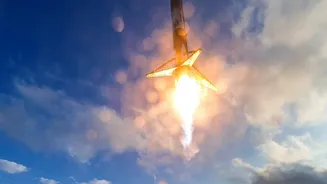
The final 30 seconds are the most critical. As the rocket approaches the landing zone, it deploys four landing legs. Then, in a manoeuvre sometimes called a 'hoverslam' or 'suicide burn', a single main engine re-ignites. This final burn must be perfectly timed, providing just enough thrust to slow the massive booster from terminal velocity to a gentle hover just metres above the ground. The engine's thrust is throttled in real-time by the flight computer, making constant adjustments to ensure a soft and vertical touchdown. The entire sequence, from atmospheric entry to landing, is fully autonomous, a testament to the complex interplay of hardware and software that makes this feat possible.
The Indian Context: ISRO's Push for Reusability
India's own space agency, ISRO, is also making significant strides in this domain with its Reusable Launch Vehicle - Technology Demonstrator (RLV-TD) programme. Unlike the vertical landing approach of SpaceX, ISRO is testing a winged vehicle, named 'Pushpak', which is designed to land horizontally on a runway like an aircraft. In a series of successful Landing Experiments (LEX), ISRO has tested the vehicle's autonomous approach and landing capabilities. These tests involve carrying the RLV to an altitude via a helicopter and releasing it to perform a high-speed, autonomous landing on a runway. These missions have successfully validated critical technologies in autonomous navigation, guidance, and control, marking a key step towards ISRO's goal of developing a fully reusable two-stage-to-orbit launch vehicle and bringing down the cost of access to space.